
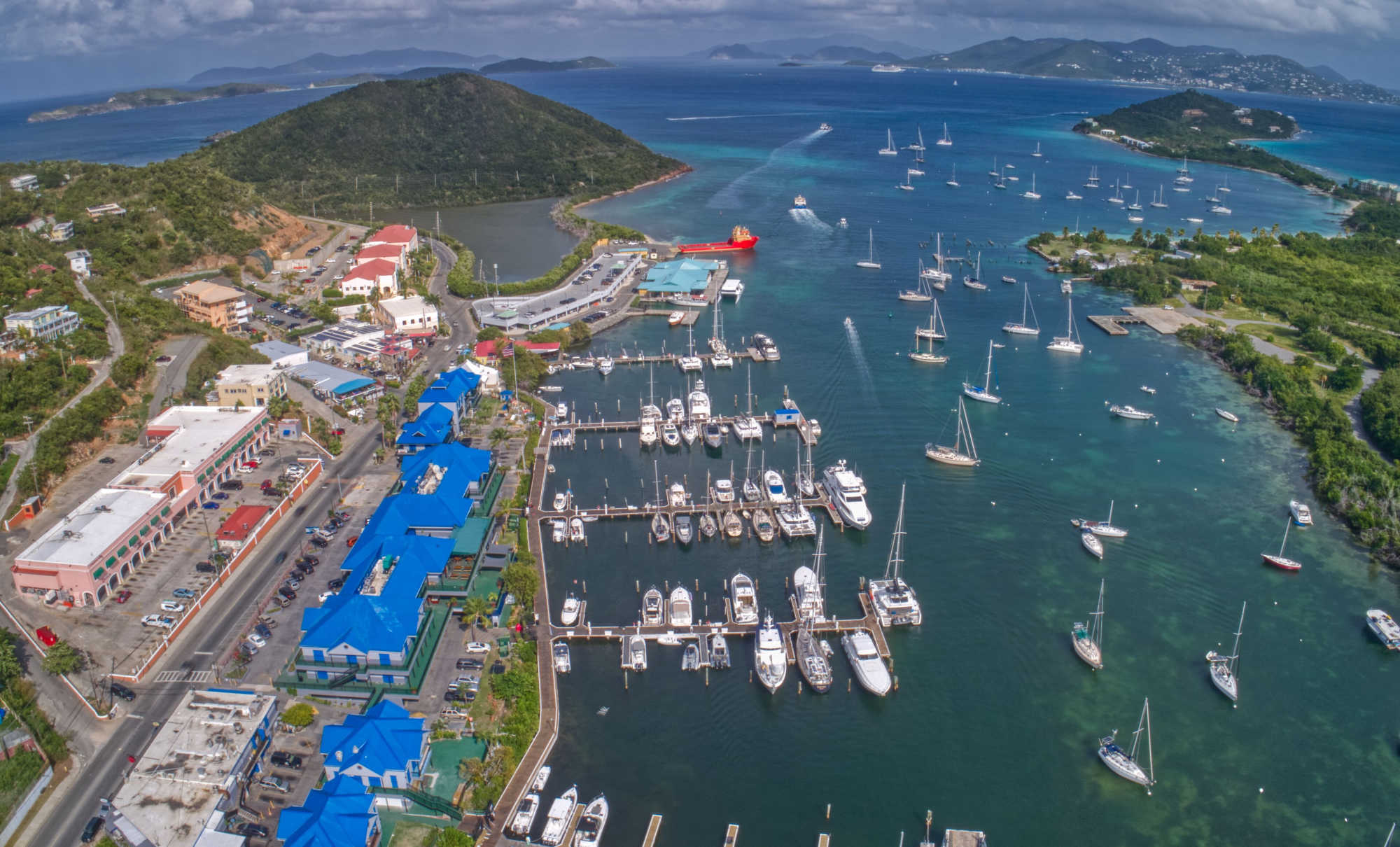
American Yacht Harbor in Red Hook, St. Thomas. Photo Credit: EXPEDIA.
American Yacht Harbor’s request for an extension of its Economic Development Commission tax benefits was paused Tuesday after EDC officials said further clarification was needed on the length of the extension being sought, even as the company outlined millions of dollars in planned upgrades to one of St. Thomas’s most important marine tourism assets.

Island Global Yachting-American Yacht Harbor St. Thomas Holdings LLC, the operator of American Yacht Harbor in Red Hook, appeared before the Economic Development Commission seeking an extension of its EDC certificate tied to additional investment in the property’s business operations, infrastructure, new construction and refurbishment.
Attorney Marjorie Roberts, appearing on behalf of the company, said American Yacht Harbor is a current EDC beneficiary operating as a category two and category three commercial real estate and marina facility on St. Thomas. The property, widely known as American Yacht Harbor, is a mixed-use commercial waterfront development on the east end of St. Thomas in the Red Hook Quarter.
The marina includes 135 boat slips that accommodate vessels ranging from 20 feet to 110 feet and serves thousands of boaters annually. The property also supports retail, food and beverage, financial, laundry, marine hardware and fishing equipment businesses.
Roberts said AYH is a subsidiary of MarineMax, a publicly traded company on the New York Stock Exchange, and benefits from its affiliation with what he described as the world’s largest recreational boat retailer.
The company’s application sought a five-year extension of its EDC certificate based on an additional investment of $2,000,500 in business and infrastructure improvements, new construction or refurbishment. It also sought another five-year extension based on an additional $1 million infrastructure investment, for what the company presented as a total 10-year extension request.
Jordan Franklin, executive vice president and general counsel for IGY, told commissioners that the EDC program has been important to the company’s confidence in making substantial private investment in the property, the marine industry, local employment and the territory’s broader tourism economy.
Franklin said IGY has invested approximately $5 million into American Yacht Harbor since 2018 through infrastructure improvements, maintenance and operational upgrades. He said the company is also planning several million dollars in capital investment during the first five years of the requested extension period.
According to Franklin, the current draft of the company’s 2027 capital expenditure budget exceeds $1 million, with a significant portion expected to go toward replacing aging wood marina decking with long-term composite materials.
He said the planned work includes dock replacement and marina reconfiguration to respond to changing boating trends, including increased demand for catamarans. Other possible projects include dredging, subject to environmental approvals, fuel system replacement, generator and utility infrastructure upgrades, structural refurbishments involving balconies and roofing systems, redevelopment or conversion of Building F restaurant areas, upgraded public bathrooms, and possible boater lounge and gym facilities.
Franklin said IGY also anticipates recurring capital investments averaging approximately $400,000 annually during years five through ten.
EDA Commissioner Andrew Penn asked the company to provide staff with a year-by-year capital expenditure breakdown, saying that given the age of the facility and the scale of planned infrastructure work, the board needed a clearer sense of timing alongside the company’s operating expense projections. Franklin said the company would provide that information in its written response to the EDC.
Penn also raised concerns about Customs clearance delays affecting boaters moving between the U.S. Virgin Islands and the British Virgin Islands, particularly those returning through St. John. He said delays can affect the length and quality of the visitor experience and urged that the concern be placed on the record.
Beth DiDomenico, general manager of American Yacht Harbor, said charter companies had not formally complained to her about the issue, but she acknowledged that the clearance process can become difficult, particularly later in the day.
The issue, Penn said, speaks to the need for government to ensure that infrastructure and manpower are sufficient to support the marine tourism product.
Commissioners also questioned IGY about local hiring, workforce development and employee advancement. Franklin said the marina is almost entirely locally staffed and works with schools in the East End and Red Hook area to provide internships. He said the company hosted eight interns last year and recently hired one of them for full-time employment.
DiDominico said American Yacht Harbor has worked with a local high school program for several years and cited examples of former interns who later joined the company or pursued additional training and careers. She also discussed the company’s practice of promoting from within, noting that she joined the company in 2012 or 2013 as an office administrator, later became operations manager, and in 2016 became general manager.
The company also pointed to long employee tenure as evidence of job stability. DiDominico said one employee, Gary Hodge, joined the company decades ago as a fuel attendant, later became gas station manager, then dock master, and now serves as marina manager. She said another employee has been with the company for about 25 years, while others have advanced into supervisory and administrative roles.
On charitable commitments, Roberts said AYH would continue contributing a minimum of $34,500 annually to charitable causes in the territory, with at least $5,000 directed toward educational initiatives each year and at least 55 percent of that amount going to the Department of Education for public school programs and initiatives. The company would also continue contributing $3,000 annually to the Territorial Scholarship Fund and $2,500 annually to the Department of Labor Fund.
DiDominico added that the company donates dockage to the V.I. Police Department for its firefighting vessel, describing that as a roughly $30,000 annual contribution outside the EDC requirement.
Commissioners also asked about hurricane preparedness and the physical vulnerability of Red Hook Harbor. Franklin said IGY has extensive hurricane protocols and actively monitors storm systems. He said the company is prepared through insurance coverage and storm readiness planning, while also noting that neighboring moored vessels and storm-damaged boats outside the marina’s control remain a difficult issue that requires local collaboration.
After the public hearing, the matter was scheduled for the EDC’s decision meeting. However, the company’s item was removed from the decision agenda after staff said further discussion was needed regarding the extension term.
During the hearing, EDC staff noted that IGY had already received approximately 20 years of tax incentives through its initial transfer and said the current request needed clarification. Staff said the additional years available under the law and the company’s request for two extensions based on aggregate investment required further review, particularly if the company intended to seek the one-time 10-year extension allowed under the statute.
Franklin said the company would like to take advantage of as much extension time as available under the law and would discuss the matter further with EDC counsel.
No final vote was taken on the IGY AYH request Tuesday. The matter is expected to return after the company and EDC staff clarify the proper structure and length of the requested extension.


Advertisements