
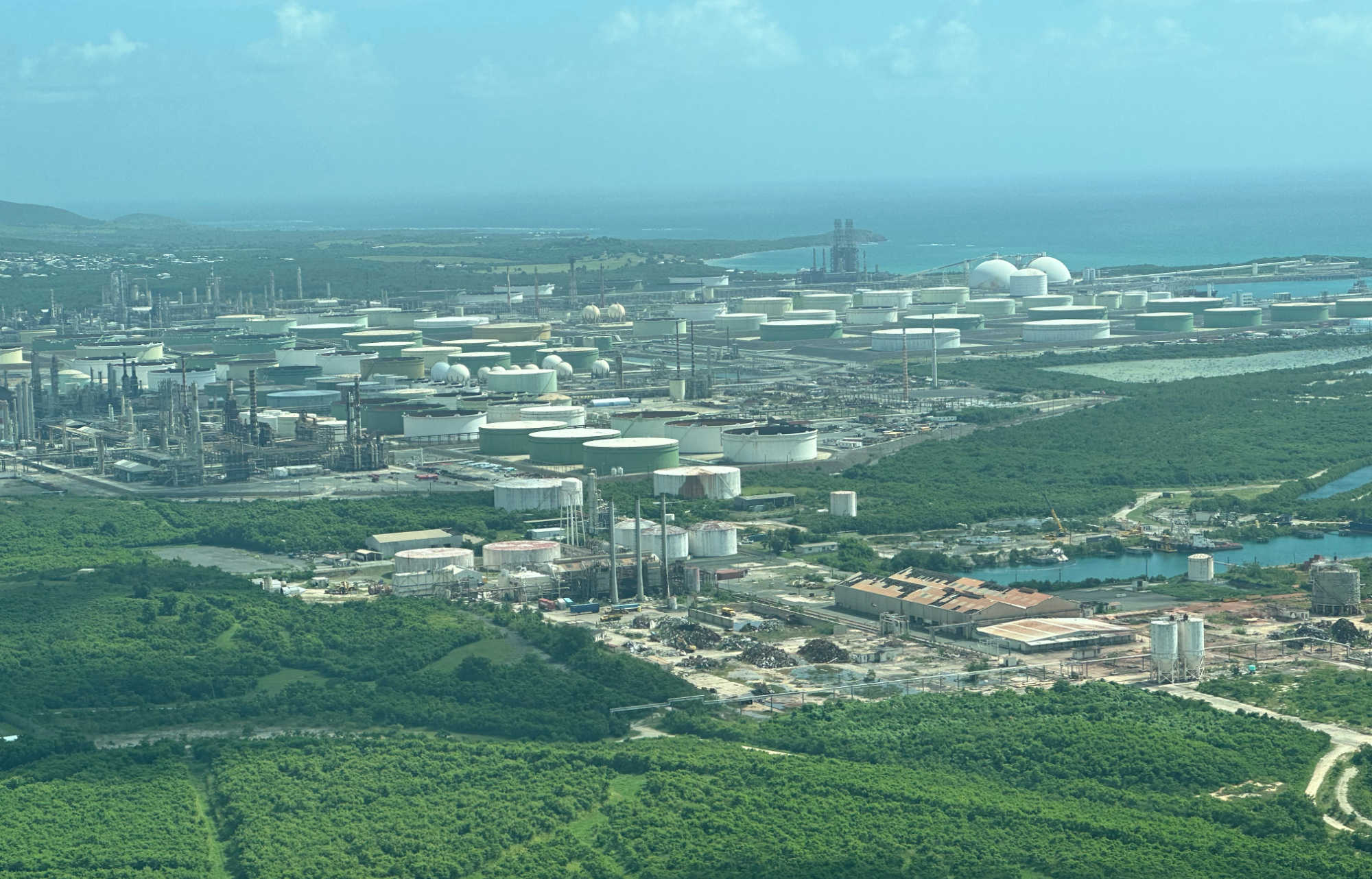
Aerial view of the oil refinery (idled) and storage terminal on the south shore of St. Croix. Photo Credit: ERNICE GILBERT, V.I. CONSORTIUM.
“We will restart the refinery. I didn't come this far to only come this far,” was the affirmative statement made by David Johnson, Director of Port Hamilton Refining and Transportation.

Mr. Johnson was one of several panelists invited to speak during the Economic Development Summit held in St. Croix on Friday. As the conversation focused on reliable energy and a consistent supply of electricity, Mr. Johnson reminded the audience that the refinery located on St. Croix’s south shore is more than capable of generating the power needed to electrify the island.
“We have permits to operate gas turbines that can make nearly 100 megawatts of power. And to put that in perspective, the whole island of St. Croix, at its peak, needs about 41,” Mr. Johnson announced. The Port Hamilton team is currently in dialogue with the Water and Power Authority “about ways that we can work together, as a neighbor on the island, and work for the common good of producing power,” per Mr. Johnson. He shared that generating more electricity ultimately reduces the cost. “We can make it cheaper for ourselves at the refinery, but also for the people of St. Croix,” he said.
This, however, will only be possible if the refinery opens. Mr. Johnson seems keen. “We are excited about the opportunity to be restarting the refinery,” he said.
He spoke of “some serious interest from investors” as well as President Trump’s oil and gas policies. “If you own an oil refinery, you're pretty happy about that,” Mr. Johnson stated. A February 2026 missive from the White House outlined several policy decisions that reflect President Trump’s “unwavering commitment to energy independence, economic prosperity, and putting America First.”
“We've got a lot of interest right now from different parts of the United States government; they would like to see this refinery restarted,” Mr. Johnson shared. Local support, he said, is also apparent. “The governor's been very supportive. The Legislature has been very supportive,” Mr. Johnson said.
Only days ago, Governor Albert Bryan Jr. asserted that reopening the refinery is a “matter of national importance.”
The Port Hamilton team is well aware that some sections of the local community do not favor the reopening of the refinery. Environmental concerns are among the primary reasons for opposition. Still, Mr. Johnson maintains that despite any pushback, “many, many, many, many, many more people come up to me and say, 'When's our oil refinery going to get restarted? And when are the jobs going to come back?’”
Formerly Limetree Bay, the refinery was shuttered in 2021 after the Environmental Protection Agency mandated pauses over environmental and toxic emission incidents. The reopening hinges on environmental compliance.
Mr. Johnson assured those listening that permits and other obligations will be taken “very, very seriously.”
The audience learned that there are “some pretty robust plans for solar” and “a pilot program for a new type of vertical access wind turbines will be employing batteries.” According to Mr. Johnson, opportunities exist to expand into “renewable and sustainable fuels like renewable diesel [and] sustainable aviation fuel.” The refinery, he said, will operate in a “responsible way.”
As far as production and export go, Mr. Johnson explained that “our plan, frankly, looks very similar to the old plan.”
Fuel produced on St. Croix will “support the Caribbean zone first,” he said. The island is also “logistically advantaged for receiving crude oils from Venezuela” as well as Guyana, Suriname, and Trinidad and Tobago, where Mr. Johnson said there is “lots of oil.”
“We have advantages over other locations because of where we are, and so you know we have a tremendous opportunity,” he maintained.

For Mr. Johnson, the refinery is not simply that, but instead is “an industrial site that happens to have an oil refinery there.” Within the more specific context of the territory’s recovery projects, Mr. Johnson announced that the man camp on the refinery’s property is “open for business.” “We have over 600 beds. Someone can move in tonight, and we can expand to over 2000 beds here on St. Croix,” he said. Port Hamilton, he said, “would love to speak to anybody who would like to partner with us and leverage our industrial site and our industrial capabilities.”


Advertisements