



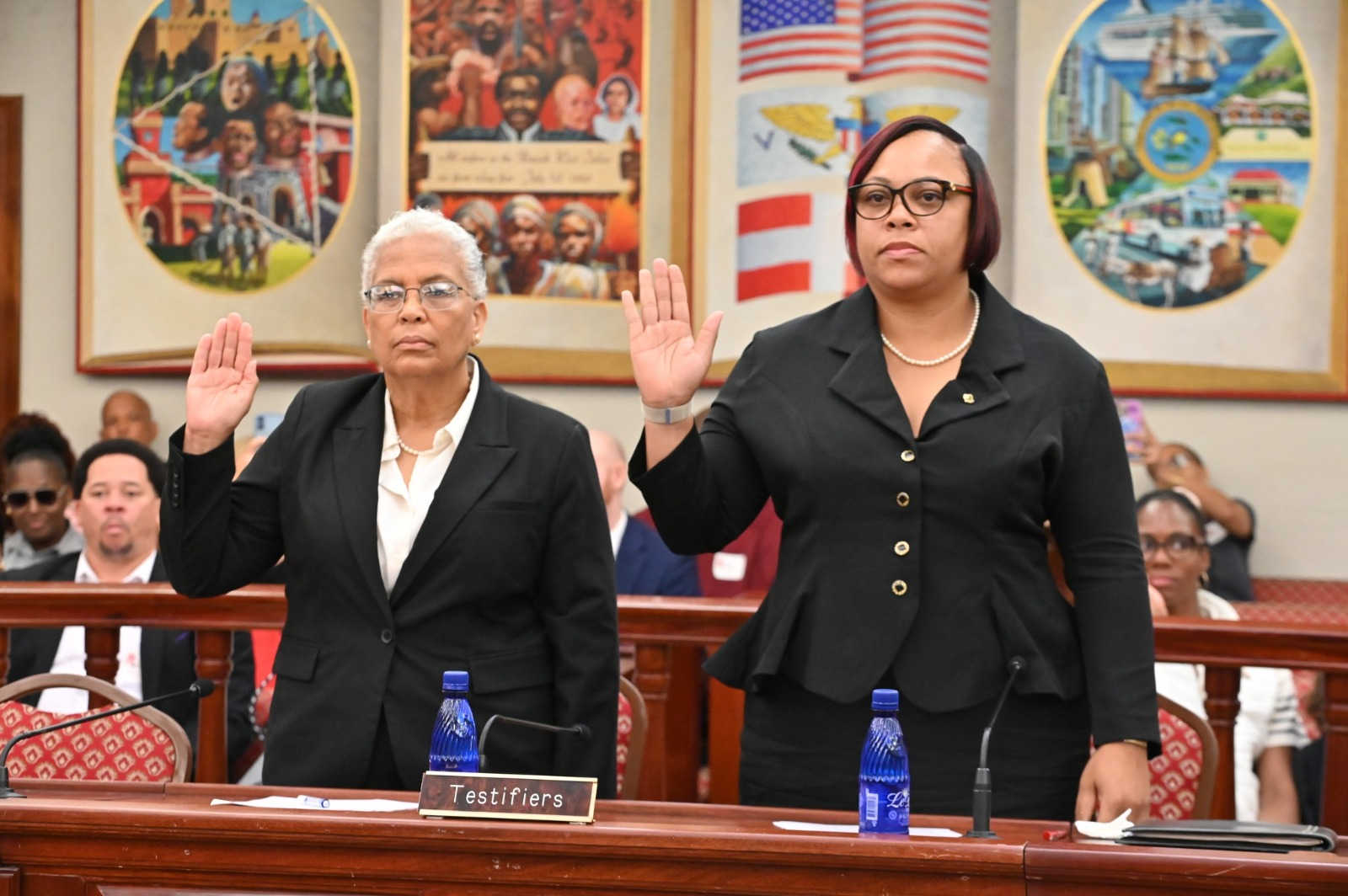
From left to right, Judge Denise Francois and Attorney Renee Andre. Photo Credit: V.I. LEGISLATURE.
Two Virgin Islanders nominated by Governor Albert Bryan Jr. for key judicial positions moved one step closer to confirmation after receiving unanimous approval from the Committee on Rules and Judiciary, where lawmakers examined their qualifications, judicial philosophies and approaches to court administration, integrity, legal ambiguity and artificial intelligence in legal filings.

Judge Denise Francois has been nominated to serve as a justice on the Supreme Court of the Virgin Islands. Francois has practiced law in the Virgin Islands for decades and has held several notable positions, including president of the Virgin Islands Bar Association. She told lawmakers that her “greatest honor and contribution to public service has been serving as a Judge of the Superior Court of the Virgin Islands since November 2013.”
The committee heard that Judge Francois has experience across a broad range of civil and criminal matters, including unlawful possession of firearms, assault, kidnapping, personal injury and defamation. She said two recent roles, including serving as administrative judge for the St. Thomas-St. John district, prepared her for the “administrative aspect” of the Virgin Islands Supreme Court. She reminded lawmakers that the court “does more than simply review appeals from the Superior Court.”
Judge Francois told the committee she would conduct herself in a way that “ensures the greatest public confidence in my independence, impartiality, integrity and competence.” If appointed, she said, she would “work to resolve all cases in an independent, fair and thoughtful manner.”
Attorney Renee Andre, nominated to serve as a judge in the Superior Court of the Virgin Islands, Division of St. Thomas-St. John, also testified before lawmakers. Andre said her interest in law began in elementary school and that she has since developed the academic and practical experience needed for the bench.
She told lawmakers that since entering private practice, she has “spent more than a decade representing individuals, families and businesses across a broad spectrum of legal matters.” Like Francois, Andre said her experience spans both criminal and civil matters, and she said she is versed in “complex, sensitive and high stakes litigation.”
“I am not influenced by status or external pressures. I approach each matter with impartiality, and I am committed to ensuring that every litigant is heard with dignity and respect,” Andre said.
If appointed to the Superior Court, Andre said she would “implement thoughtful case management strategies to reduce backlog and improve the timely resolution of cases.” She also pledged to “expand the use of technology within the courtroom and to make the judicial process more accessible and understandable for pro se litigants.” Andre further said she remains “committed to upholding the highest standards of integrity, avoiding both actual conflicts and the appearance of impropriety.”
The two nominees drew favorable reactions from lawmakers. As is typical in judicial confirmation hearings, senators asked about reducing court backlogs, avoiding conflicts of interest and maintaining integrity in a small community.
Committee Chair Carla Joseph questioned both nominees on how they would approach ambiguous laws. During the 35th Legislature, former Senator Diane Capehart, who chaired the Committee on Rules and Judiciary, undertook an effort to clean up laws containing minor errors.
Andre said that when faced with ambiguity, she would begin by identifying existing precedent. “I would analyze and apply that precedent and make my ruling,” she said.
Senator Kenneth Gittens asked about the increasing use of artificial intelligence in courtrooms, particularly AI-generated legal research. Francois said there are tools available to assess the validity of legal submissions.
At the same time, she said she was encouraged that there had not been any “blatant examples of AI hallucinations, where the lawyers will submit a brief that they have had their AI legal research program generate without them checking.”
With all seven members of the committee voting in favor of both nominations, Francois and Andre are now one step closer to assuming their new roles.



Advertisements