


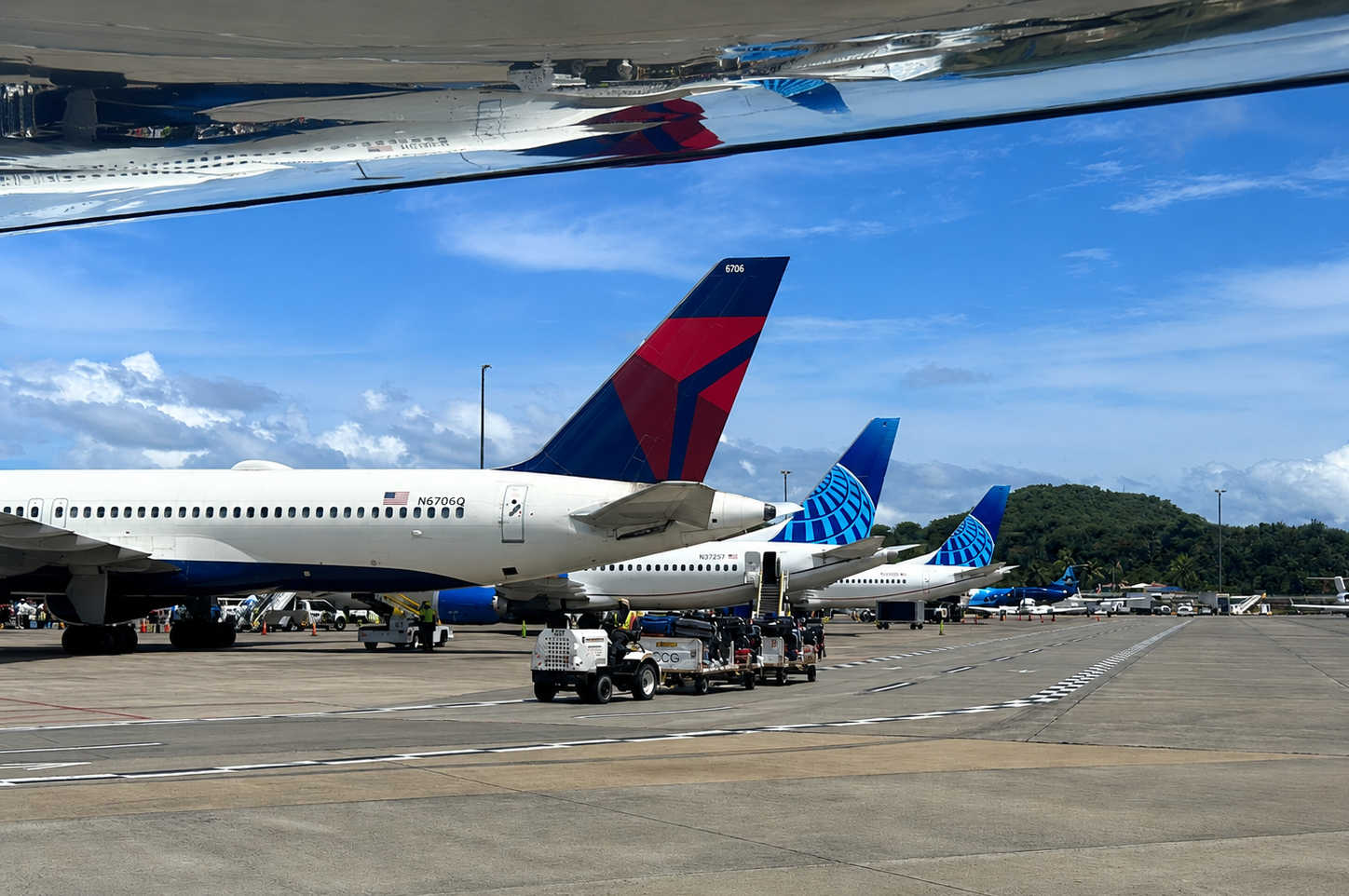
Major carriers at the Cyril E. King Airport on April 25, 2026, as airlines serving the USVI warn VIPA’s proposed airport P3 could raise costs, weaken regional competitiveness, and threaten sustainable air service to the territory. Photo Credit: ERNICE GILBERT, V.I. CONSORTIUM.
Major airlines serving the U.S. Virgin Islands are warning that the Virgin Islands Port Authority’s proposed airport public-private partnership would make the territory’s airports more expensive than competing regional airports and could place air service at risk. The carriers say they remain opposed to any model that is not economically supportable and will not enter into a lease, operating agreement, or rates-and-charges arrangement based on VIPA’s current structure.

In a June 3 letter to Governor Albert Bryan Jr. and VIPA Interim Executive Director Ava Penn, the USVI Airlines Airport Affairs Committee also said its members are reserving all rights regarding procedural alternatives, signaling that additional formal action could be considered if VIPA continues on its current path.
The letter represents a sharp escalation in the long-running dispute over VIPA’s full-scope airport P3 program, which the airlines say exceeds $1 billion and relies on a tariff-driven rate structure they view as unaffordable. While the carriers say they remain committed to improving the territory’s airports, they are urging VIPA to shift course and consider a phased $300 million capital core program developed by the airlines as a more practical alternative.
The airline committee said its members are essential to the territory’s economic vitality and connectivity, supporting tourism, commerce, and access for residents and visitors. The group said its members have long supported the U.S. Virgin Islands market, with American Airlines through Trans Caribbean Airways beginning service in 1969, Delta Air Lines beginning in 1991, United Airlines through Continental serving before 1990 and more consistently since 1999, Cape Air beginning in 1998, Sun Country beginning in 2004, JetBlue beginning in 2011, and Southwest beginning service in February 2026.
The airlines also noted that Frontier Airlines and Spirit Airlines, which no longer serve the territory, had shared the same concerns about the P3 program as the current carriers. The letter states that Spirit began serving the USVI in 2005 and ceased operations in 2026, while Frontier began serving in 2021 and ceased operations in 2026, already reducing available seats to and from the islands.
The committee said that despite paying VIPA-imposed fees that should be used to operate and improve the airports, its members have been disappointed by what they described as a lack of transparency in how those funds are used for facility improvements, particularly when compared with surrounding airports in the region.
The airlines also criticized the way VIPA’s original P3 program was selected. According to the letter, the initial P3 approach was chosen unilaterally by VIPA without airline consultation on whether the program was operable, affordable or constructible. The carriers said that at no point during the request for proposals or solicitation process were they consulted or brought in to discuss the program’s scope or the selection of the P3 model.
Notwithstanding those concerns, the committee said its members have devoted significant time and resources over the past two years, in good faith, to work with VIPA and the P3 team on a viable solution for the territory’s airports. But the airlines said those efforts demonstrated that the P3 was not capable of delivering a sustainable outcome, prompting them to shift focus toward developing a practical and deliverable alternative.
That alternative is a phased $300 million capital core program that the airlines say was developed over the past year through collaboration, dialogue, technical submissions and concept drawings delivered earlier in May. The proposal, according to the committee, offers a dual-prong solution focused on stabilizing airport operations through a third-party operator and creating a sustainable, financially responsible capital plan with a clear path for future pre-approved projects.
The committee said the alternative provides a path toward operability, near-term capital to address immediate infrastructure needs through pre-approved projects, and a scalable framework for additional future investments. The airlines described the proposal as evidence of their continued commitment to a cost-effective solution that they say VIPA’s initial P3 cannot deliver.
The carriers said they are concerned that VIPA remains unmoved in its commitment to the P3 program even after the airlines agreed to the governor’s request for additional discussions. They also objected to VIPA’s dismissal of their $300 million alternative in favor of the larger P3 proposal.
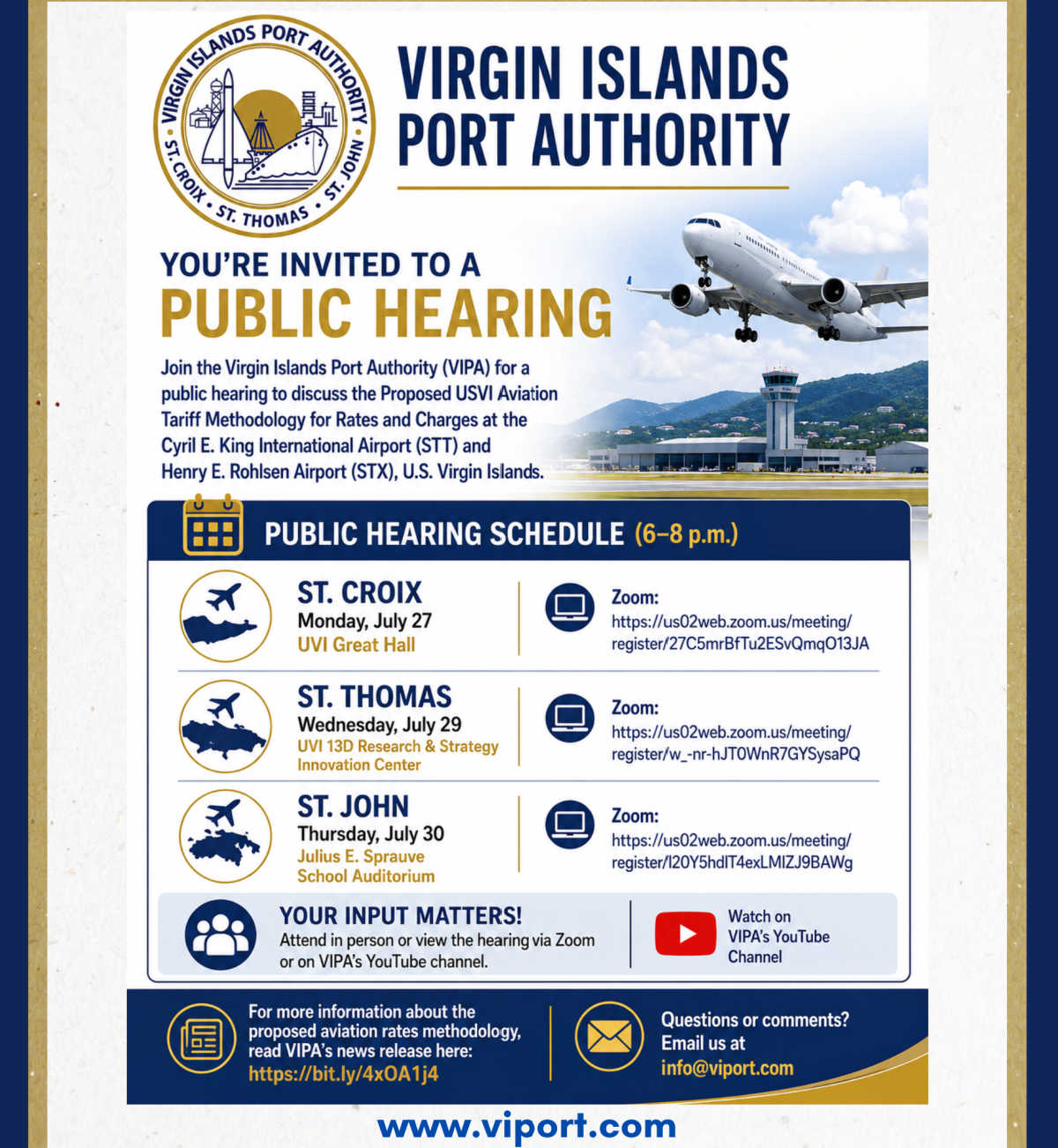
The airlines argue that a direct partnership between VIPA and the carriers remains the only viable and sustainable path to improving airport facilities and maintaining efficient operations at Cyril E. King Airport on St. Thomas and Henry E. Rohlsen Airport on St. Croix.
Departing from that approach, the committee warned, would create an unsustainable economic environment for airlines in an already volatile landscape and could place at risk the ability of Virgin Islands residents to access a robust schedule of flight options to and from the territory.
The committee was especially firm in its opposition to the rate structure tied to VIPA’s current plan. The airlines said the full-scope P3 and tariff-driven rates remain unacceptable because of affordability constraints and because they significantly deviate from typical airport financial models.
According to the carriers, the proposed structure would make USVI airports more costly than other airports in the region with which they compete for air service and travelers. The airlines said they strongly urged VIPA and the governor to reconsider that position.
While the letter outlines deep opposition to VIPA’s current direction, the airlines said they remain open to meeting with VIPA during the week of June 8, 2026. However, they conditioned that willingness on VIPA confirming that it will accept the $300 million capital core program proposed on May 13, 2026, and demonstrating a willingness to consider an alternative to the P3.
The letter closes by stating that the airlines share VIPA’s goal of improved airport facilities, but cannot ignore the need to ensure operational and economic sustainability for a program of this magnitude in the Virgin Islands.
The Port Authority told the Consortium that it was reviewing the letter and would not comment at this time.

The letter was signed by Lorin Carr, AAAC chair for American Airlines; Rich Rivero of Delta Air Lines; Zanell Roberts of United Airlines; Amber Verloove of JetBlue Airways; Charles Ferrara of Cape Air; Charles Breer of Sun Country Airlines; Kenneth Gregg of Southwest Airlines; and Sharon Pinkerton of Airlines for America.


Advertisements