

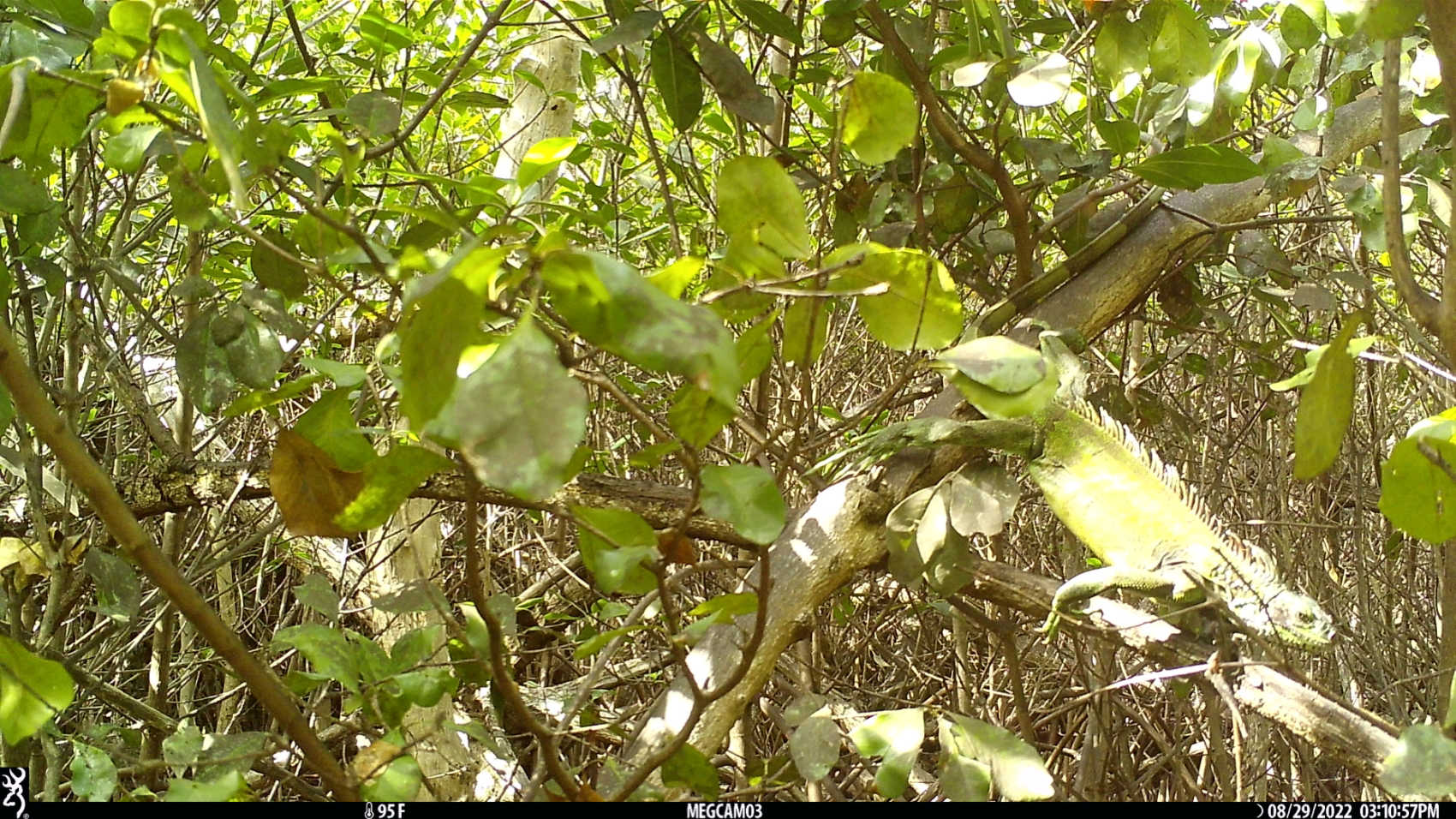
A green iguana moves through coastal mangroves, one of the non-native species documented by researchers at Magens Bay in a continent-wide study of wildlife in coastal wetlands. Photo Credit: UVI.
A continent-spanning study that included Magens Bay on St. Thomas found that coastal wetlands support a much broader range of wildlife than many people realize, while also warning that rising seas and more frequent flooding could reduce the value of those habitats over time.

The research, led by the National Estuarine Research Reserve System in collaboration with University of the Virgin Islands researchers Dr. Kristin Wilson Grimes and Allie Durdall, used motion-activated cameras across sites from Alaska to Hawaiʻi, Mexico, and the U.S. Virgin Islands to document how mammals, birds, and reptiles use wetlands, often in ways rarely seen by people.
The study was funded by the NERRS Science Collaborative, which supports community-driven science aimed at protecting communities, ecosystems, and economies along the nation’s coasts. Magens Bay was one of three island locations represented in the project, which included 32 sites in total. Using 109 motion-activated cameras, researchers recorded 146 species of mammals, birds, and reptiles.
The images captured animals ranging from bears in Alaska and feral hogs in Mississippi to armadillos in Florida and the Koloa Maoli, Hawaiʻi’s native duck. The study notes that many of these animals are active at night and are seldom seen by visitors, making camera traps a useful way to understand how wildlife uses wetlands.
“The cameras not only shed light on which animals were there, but also what they were doing,” said Dr. Kerstin Wasson, one of the project’s lead scientists and research coordinator at the Elkhorn Slough Reserve in California. “At every Reserve, we saw how important wetlands are as nursery habitats for many species and how they provide foraging opportunities and resting refuges.”
In the U.S. Virgin Islands, researchers at Magens Bay observed six species, including non-native animals such as the Javan mongoose (Urva javanica), the black rat (Rattus rattus), and the green iguana (Iguana iguana), along with native bird species including the Pearly-eyed Thrasher (Margarops fuscatus) and the Yellow Warbler (Setophaga petechia). Of the 32 participating sites, the U.S. Virgin Islands was among only 12 where non-native species were observed, and those species made up 60 percent of observations.
Miranda Goad, a UVI master’s graduate in marine and environmental science who assisted with the study, said, “This study shows how important it is for us to understand our local ecosystems, what’s happening in them, and how they’re being used. Our coastal ecosystems are our most valuable natural resource and deserve our utmost care and stewardship.”
According to the study, this was the first coordinated assessment of wildlife in coastal wetlands across North America. Because the same methods were used at every site, scientists were able to compare wildlife use across regions at a scale that had not previously been achieved. The findings also challenge the view that wetlands mainly benefit fish and birds. Researchers documented large predators such as mountain lions, black bears, and wolves alongside more commonly expected species like coyotes and raccoons, underscoring how closely wetlands are linked to surrounding uplands and how protecting them requires a landscape approach.
The study also points to future risks. Researchers found that wildlife activity dropped sharply during high tides, suggesting that as sea levels rise and marshes flood more often, these habitats may become less usable for many species. Wetlands that cannot move inland or build elevation, the study says, could lose much of their wildlife value.
“These results highlight why it is so important to protect our islands’ wetlands. USVI mangroves support a variety of wildlife. Understanding what’s there and how these animals are using these environments informs our local management and restoration practices,” said Grimes.



Advertisements