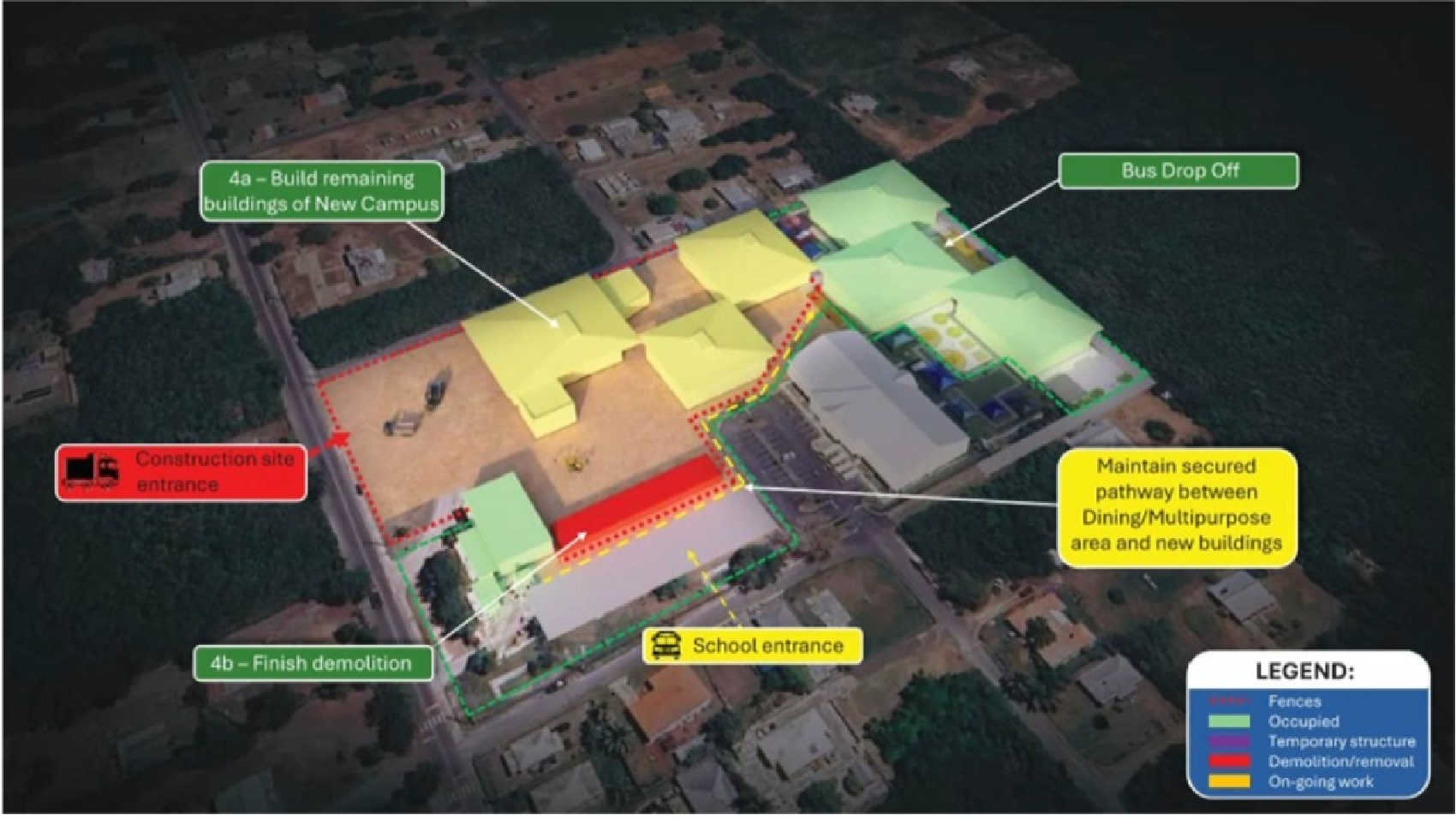
Claude O Markoe Pre-K-8 School phasing plans design. Photo Credit: CZM.
Plans to redevelop the Claude O. Markoe and Alexander Henderson schools on St. Croix are moving through the review process, but Thursday’s public meeting before the Coastal Zone Management Commission made clear that the projects are being shaped by three major pressures: student and community safety, rising construction costs, and the challenge of managing work around active school operations.

The meeting focused on federal determination applications for both campuses. Officials from the Virgin Islands Department of Education, along with representatives from the master planning and contracting firms working on the projects, presented an overview of what the new schools are expected to look like and how they are intended to function.
Pam Loeffelman, senior principal with DLR Group, said the campuses are being designed around collaboration rather than the traditional school layout. “It's not your typical kind of double loaded corridor with classrooms on both sides, or in the case of the Virgin Islands, a lot of times, single loaded quarters,” she said. “It's really about putting together those places of teaching and learning together so that students can interact together and with teachers and really teach and learn within that collaboration that's so important in today's world.”
For the Claude O. Markoe School, the design seeks to preserve and strengthen the campus’ existing community identity. “This is so clearly a community school,” Ms. Loeffelman observed. The new construction will be oriented to better highlight the school’s well-known “sausage” tree, while another iconic feature — the school’s murals — will also be preserved and incorporated into the new campus.
Those preservation plans drew concern from CZM commissioners, who questioned how the murals would be protected and restored. Ms. Loeffelman said the mosaic tile artwork should be relatively easy to remove and reinstall. However, at least one mural was likely painted directly onto the school walls, making preservation of the original artwork nearly impossible. In that case, she said, a high-resolution photograph would be taken and printed on canvas, then reinstalled in the new facility “so that the history…is transferred to those new buildings.”
The new Alexander Henderson campus will also be designed around a notable tree on the property, with a reoriented layout intended to make the campus more welcoming and more efficient.
Both schools are being designed to be self-sufficient in water and electricity needs at the first level, relying on municipal supplies only when rooftop cisterns and solar micro-grids are unable to meet demand.
Education Commissioner Dionne Wells-Hedrington was asked about the plan to house students from pre-kindergarten through eighth grade on the same campus at the new Claude O. Markoe School. She said the model is not new to the territory. “We have had a preK to eight school for a number of years; it was actually preK to nine,” she said. “It was the first school in the territory, which was on the island of St. John.”
Dr. Wells-Hedrington said the preK-to-eight model is the direction selected for public education in the territory under the Facilities Master Plan developed “maybe two, three years ago.” That plan, she said, was developed “by the new schools advisory board that included members of the community, stakeholders from the board, from the legislature, etc.”
Several schools already operate under the preK-to-eight structure, she noted, including Eulalie Rivera and Juanita Gardine schools.
“It allows our school campuses to nurture our students in a way that there is ownership and consistency in tracking our students. It allows for more collaboration between elementary and middle schools, and it gives us a sense of school community.” she argued. “As we navigate and rebuild our schools, we're building them in a way that there is still that consistency of collaboration and work with our students, but they’re kind of like little parts within the school community.”
Project sequencing became a major point of discussion after a question from the public. Officials initially described a four-year construction timeline for Claude O. Markoe, with new campus buildings possibly beginning in late 2026. Students would move into the new buildings once completed sometime in 2028, after which the old buildings would be demolished. Officials said demolition would be coordinated to limit the impact of noise, dust, and disruption on students.
Community member Russ Christopher suggested a different approach, arguing that Alexander Henderson should be completed first because that campus has been vacant for an extended period. “Common sense and intelligence and respect for our children would tell you to focus on Alexander Henderson first,” said Mr. Christopher. “Finish that project and then move the children from Claude O. Markoe to Alexander Henderson and have the Claude O. Markoe project completed,” he suggested.
Officials estimate that construction of the Alexander Henderson school can be completed in three years because it is not currently an active facility with students on campus.
Department of Education officials said the expected capacity at Alexander Henderson would not be large enough to accommodate the entire displaced student population from Claude O. Markoe. “We wanted to try to build the maximum capacity first,” said VIDE architect Chaneel Callwood. Still, she said the process described by Mr. Christopher “is something that we do have under consideration.”
Ms. Callwood said the final decisions are being driven largely by student safety. Before construction logistics can be completed, extensive hazardous materials testing must be performed on the sites and existing buildings. “Once we get those test results, we’ll know what we’re talking about and what we’re dealing with, and we will adjust accordingly, if needed.”
The projects are also being pushed by the same financial pressures affecting the territory’s broader recovery work.
“We are up against the escalation cost,” Ms. Callwood declared. “While FEMA has allocated funding for the campuses, the costs go up every day, but the amount that FEMA has given us will not increase. It's capped, so that is part of our drive to build as much new space as quickly as possible. So we really are working to try to get the most built, and also negotiating with contractors so that we are not paying unfair prices.”
Avoiding the same budget problem that affected the full buildout of the Arthur Richards school remains a priority for the Department of Education. “We don't expect that to happen with this particular project, but we are up against time, so that has been our driving force.”
Ms. Callwood said the project team is still taking public feedback seriously, including suggestions that work begin with Alexander Henderson School. “Our goal is to get students into new buildings that are not falling down around them, that do not have mold and other problems, as quickly as possible,” she said.



Advertisements