

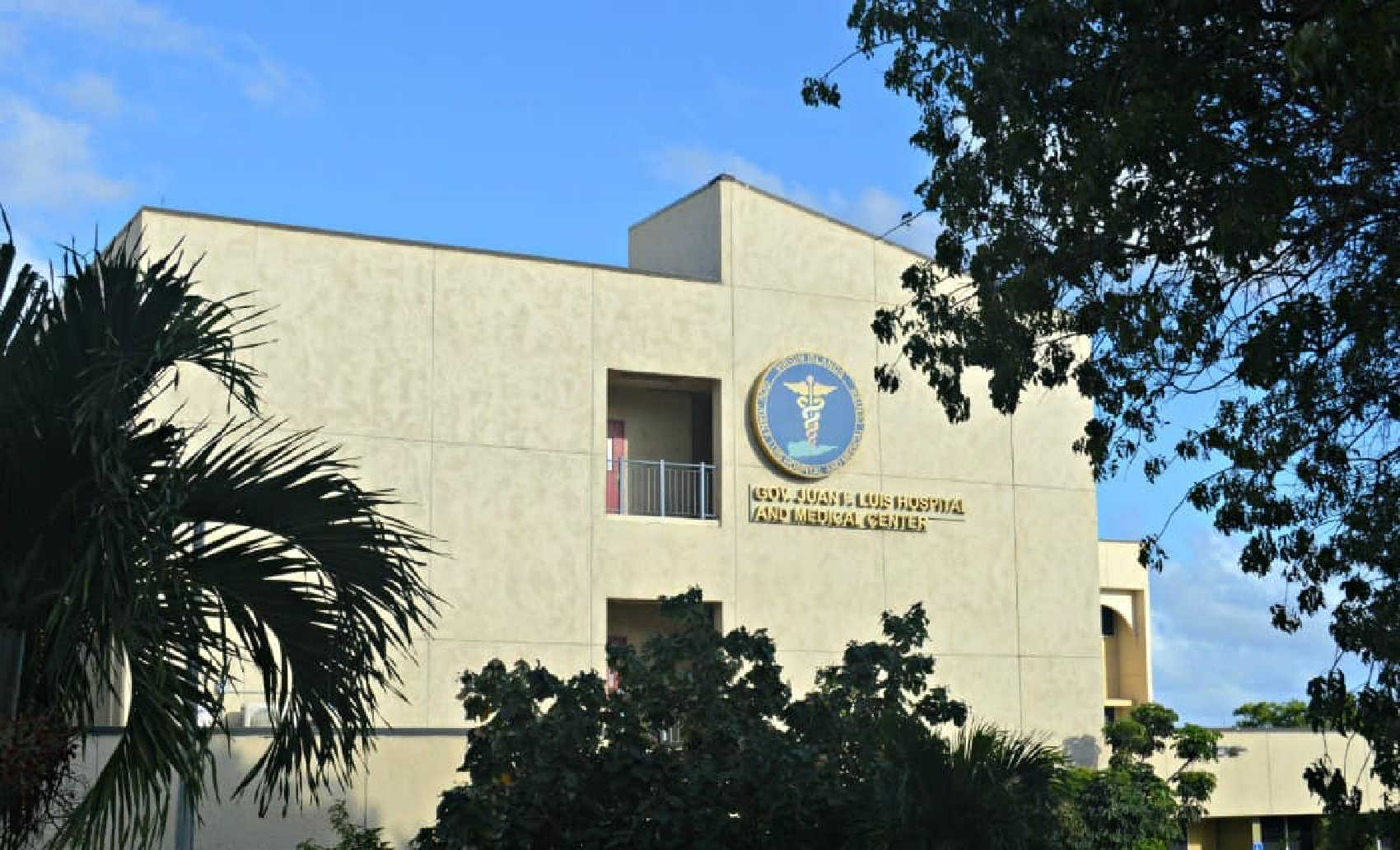
The Juan F. Luis Hospital's main facility, scheduled for demolision. Photo Credit: ERNICE GILBERT, V.I. CONSORTIUM.
Hospital officials say several key infrastructure projects tied to the Governor Juan F. Luis Hospital and Medical Center are moving forward on St. Croix, but that each remains affected in different ways by construction timing, weather, funding, utility issues, and permitting.

During a meeting Wednesday with members of the Territorial Board in the St. Croix district, Hospital Redevelopment Team Executive Director Darryl Smalls gave updates on the dialysis facility, the five-acre JFL North support site, the Cassava Gardens project, and the eventual demolition and reconstruction of the main hospital structure.
Mr. Smalls said the dialysis project is now about 180 days from completion.
“The full renovation activities begin next week,” he told board members. “You’ll start to see fencing going up, the contractor mobilizing to the site — all of those activities.”
He said “full force construction” is set to begin on April 27 and will continue through the remainder of the project until completion.
According to Mr. Smalls, contracts are already in place for critical systems, including the reverse osmosis water treatment system. He also said solicitations for fixtures, furniture, and equipment are underway in hopes of ensuring everything is in place for an on-time opening.
Turning to the five-acre lot east of JFL North, Mr. Smalls said major excavation and construction are now underway for the promised parking lot with more than 200 spaces.
He said the project has been affected by significant rainfall in recent weeks, forcing adjustments to the work schedule. Even so, the target remains completion by late June, with possible occupancy in July.
Mr. Smalls also reminded board members that the construction includes a 10,000-square-foot utility building intended for medical records, dietary storage, and maintenance.
He said the Cassava Gardens project has also experienced delays.
According to Mr. Smalls, although 95 percent of the project funding comes from the Federal Emergency Management Agency, the required 5 percent territorial match is not being disbursed on time.
“That has also contributed to some of the delays in payment to the vendor,” Mr. Smalls said.
Even with that issue, he said the team is continuing to work with the vendor and reassure them that efforts are being made to speed up payments. “We continue to try to work with the vendor and assure them that we’re doing everything humanly possible to expedite and make the payments more timely than they have been in the past.”
He said another obstacle is the lack of permanent power at the site.
According to Mr. Smalls, the Water and Power Authority has promised to address that issue. “We had some positive discussions on Monday with the electrician…in their communication with WAPA,” Mr. Smalls said. “I’m hopeful by next week, I’ll be able to report back to leadership when we can anticipate the actual permanent power to the facility.”
He said no estimate can be given for occupancy of the building until permanent power is installed.
On the issue of demolishing and rebuilding the main hospital structure, Mr. Smalls said a pre-construction contract has already been executed, but cautioned that considerable time has passed since the initial architectural plans were drawn. Because construction costs have risen significantly since then, he said the next step is to meet with stakeholders and determine how to move forward.
“What we need to look at is making sure that the key service lines that we all asked for and demanded that be part of the project, remain intact within the project,” Mr. Smalls said. At the same time, he said there must also be discussions about “opportunities for optimizing” the project.
Mr. Smalls told board members he could not yet give a date for when actual ground-breaking activity would be visible. “Unfortunately I cannot give a date when you’re actually going to see shovels in the ground,” he said, explaining that the team is still waiting on one final permit from the federal government.
He also said the enabling projects — including the five-acre site, dialysis, and Cassava Gardens — must be completed before the hospital contractor can begin demolition activity.
Still, Mr. Smalls said demolition work could possibly begin in “the latter part of the summer.”
Board Chair Christopher Finch cautioned that even once demolition begins, most of the initial work will happen inside the structure.
“There won’t necessarily be anything for people driving by to see in the early stages of that…there won’t be a lot of wrecking balls."



Advertisements