




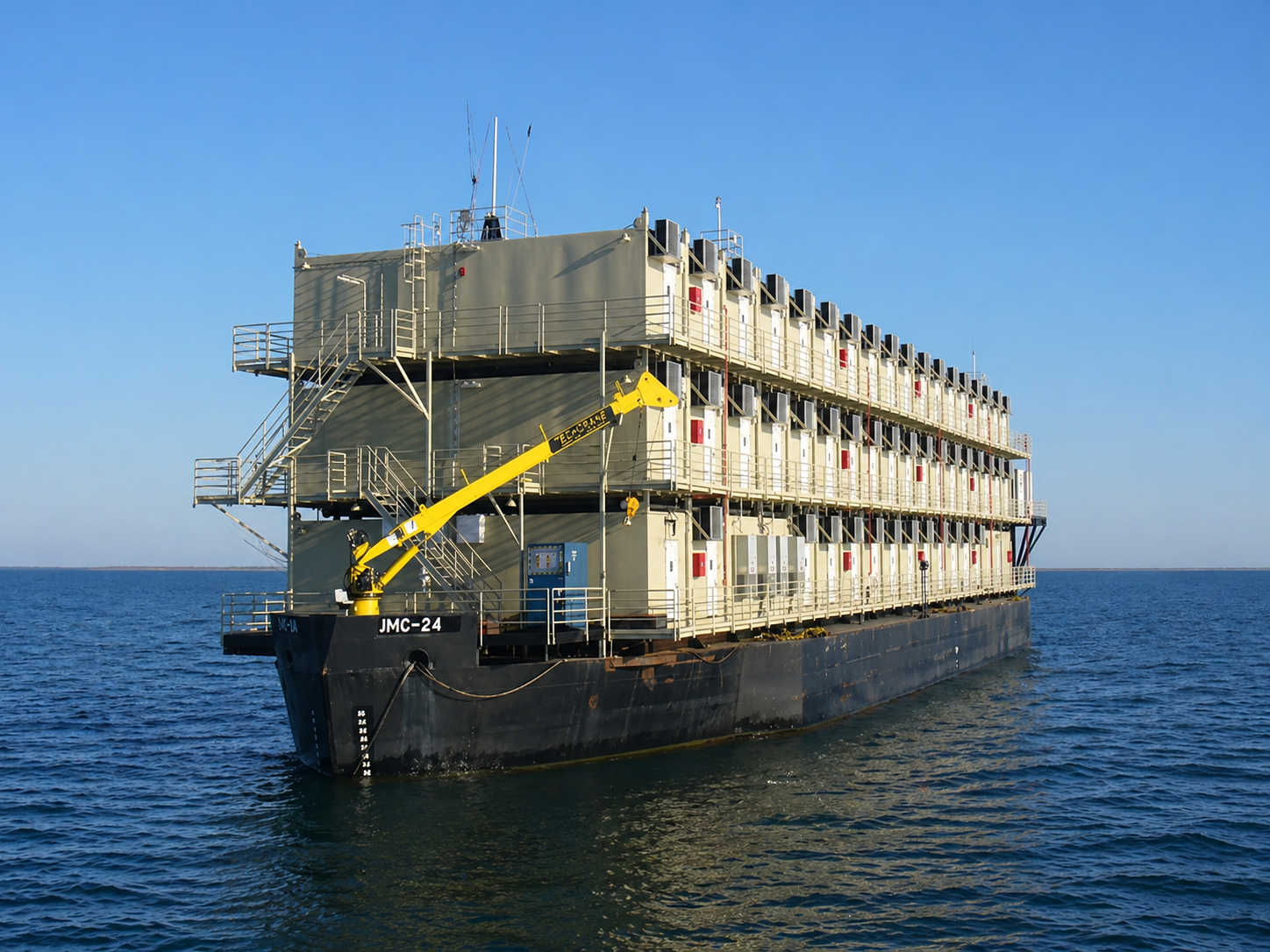
A marine housing barge, similar to the type discussed as a temporary option for accommodating hundreds of skilled workers needed as the USVI’s disaster recovery construction moves toward its expected 2028 peak. Photo Credit: V.I. CONSORTIUM.
With disaster recovery construction across the Virgin Islands accelerating toward an expected peak in August 2028, officials say one of the territory’s biggest obstacles may not be the projects themselves, but where to house the thousands of workers needed to complete them.

During Friday’s meeting of the Committee on Disaster Recovery, Infrastructure, and Planning, Office of Disaster Recovery Director Adrienne Williams-Octalien said the territory will need about 5,500 additional skilled workers at peak construction, while lawmakers and contractors explored a range of housing options — from temporary worker compounds and barges, to vacant hotels, shuttered schools, and other government-owned properties.
According to Ms. Williams-Octalien, disaster recovery projects are gradually moving into a more intense phase, with construction expected to reach its high point in August 2028.
By that time, she said, the territory will need approximately 5,500 more skilled workers to maintain construction activity and keep projects on schedule.
She told lawmakers that attracting that workforce is only part of the challenge, because those workers will also need places to live.
“Workforce housing is also a persistent and structural challenge,” Ms. Williams-Octalien said.
She said the housing shortage is rooted in limited land and “limited available housing inventory.”
To address that problem, ODR is examining several possibilities, including “international temporary housing solution providers” with experience operating in places facing conditions similar to those in the Virgin Islands.
The options under review include new International Standard Worker Compounds, refurbished compounds commonly referred to as man camps, renovated vacant hotels, and marine-based solutions.
Ms. Williams-Octalien said the marine-based option refers to barges that can house hundreds of workers.
That concept was outlined by AMC Civil President Kenneth Canty, who told lawmakers that “temporary marine housing can serve as an efficient supplement to the existing housing stock, without competing directly with residents for scarce on-island accommodations.”
Mr. Canty said the barges offer a more “flexible” solution because they are temporary, scalable, and do not require neighborhood rezoning, new land-based infrastructure, or “added pressure on the local market.”
He said the barges being discussed can house about 288 people each. He also said they include galley facilities, dining areas, recreation spaces, infirmaries, laundry facilities, reverse-osmosis water-making capability, and storage for fuel, waste oil, waste water, and potable water.
Mr. Canty said the use of barges is only one option under discussion and that the concept is being presented to contractors, who are also responsible for recruiting the workforce needed for the projects.
Senator Angel Bolques Jr. asked about the cost of using barges for housing. Mr. Canty replied that pricing would depend on several factors, including the number of workers housed and the length of use. Senator Bolques noted that issues such as docking security and possible environmental effects would also have to be taken into account.
Senator Novelle Francis said he was open to the idea of barges or floating hotels, but also suggested using shuttered schools as possible workforce housing. He estimated that the Alexander Henderson, John Woodson, and Charles Emmanuel schools could collectively provide about 100 rooms.
Ms. Williams-Octalien responded that funding restrictions make that approach more complicated than simply deciding to refurbish former school buildings. “Where will we take that money to rehab the school from?” she asked. She said ODR’s preferred approach is to let contractors develop their own housing solutions. “We're relying on them and providing the mechanism for which we can charge these costs that will be a part of their contract,” she explained to Senator Francis.
Senator Francis remained skeptical, saying he did not believe the territory would produce “enough housing to accommodate that, as well as our needs within the local system.” Still, he said he looked forward to ideas that could make use of existing infrastructure.
The discussion also revealed how fluid some of the planning remains. Ms. Williams-Octalien said ODR had considered using the man camp attached to the refinery on St. Croix, but that possibility has changed because there is now a “potential buyer for the refinery, so that is not really a priority for that company.”
At the same time, she said one unnamed company is exploring the purchase of property to build a housing solution, and that several companies are “out there looking for resources” and continuing to share potential plans with ODR.
Senator Clifford Joseph cautioned against building too many permanent structures for workers who are unlikely to remain in the territory once the projects are finished.
“Some consideration got to go into limiting how much building we going to allow of any kind,” he said.
He warned that if permanent worker housing is built without long-term use in mind, it could add to the Virgin Islands’ inventory of derelict buildings once construction winds down.
Ms. Williams-Octalien tried to ease that concern by saying one company is looking at housing that is “collapsible after the time is completed.” She added, however, that ODR’s discussions with contractors “does not preclude them from utilizing the existing resources.” One company, she said, is exploring the purchase of a hotel on St. Thomas.
Senator Kurt Vialet argued that the first priority should be fully using what is already available in the territory. Referring to the refinery’s man camp, he said there appeared to be more than enough space.
“Even if there is a possibility of reopening the refinery, they're only going to be utilizing 500 beds. So there's still over 1000 beds available,” Senator Vialet said. “We need to max out everything that the Virgin Islands have. So if you have a man camp, you max it out…After you max out everything, then you begin to think about where else we could go.”
He also said that because the government owns thousands of acres of land, contractors could lease public property for workforce housing, creating income for the territory. Senator Vialet further noted that the government owns many old buildings that could be leased to contractors, then later return to government ownership in improved condition.

Whatever solution is ultimately chosen, the timeline is tightening. With recovery construction expected to peak in August 2028, the territory has just over two years to determine where those 5,500 additional skilled workers will live. If that housing challenge is not solved, the USVI risks slowing construction at the very moment projects are supposed to accelerate, weakening its ability to spend the major FEMA disaster recovery dollars tied to Hurricanes Irma and Maria before the 2035 deadline and threatening the greatest rebuild opportunity in the territory’s history.


Advertisements


