

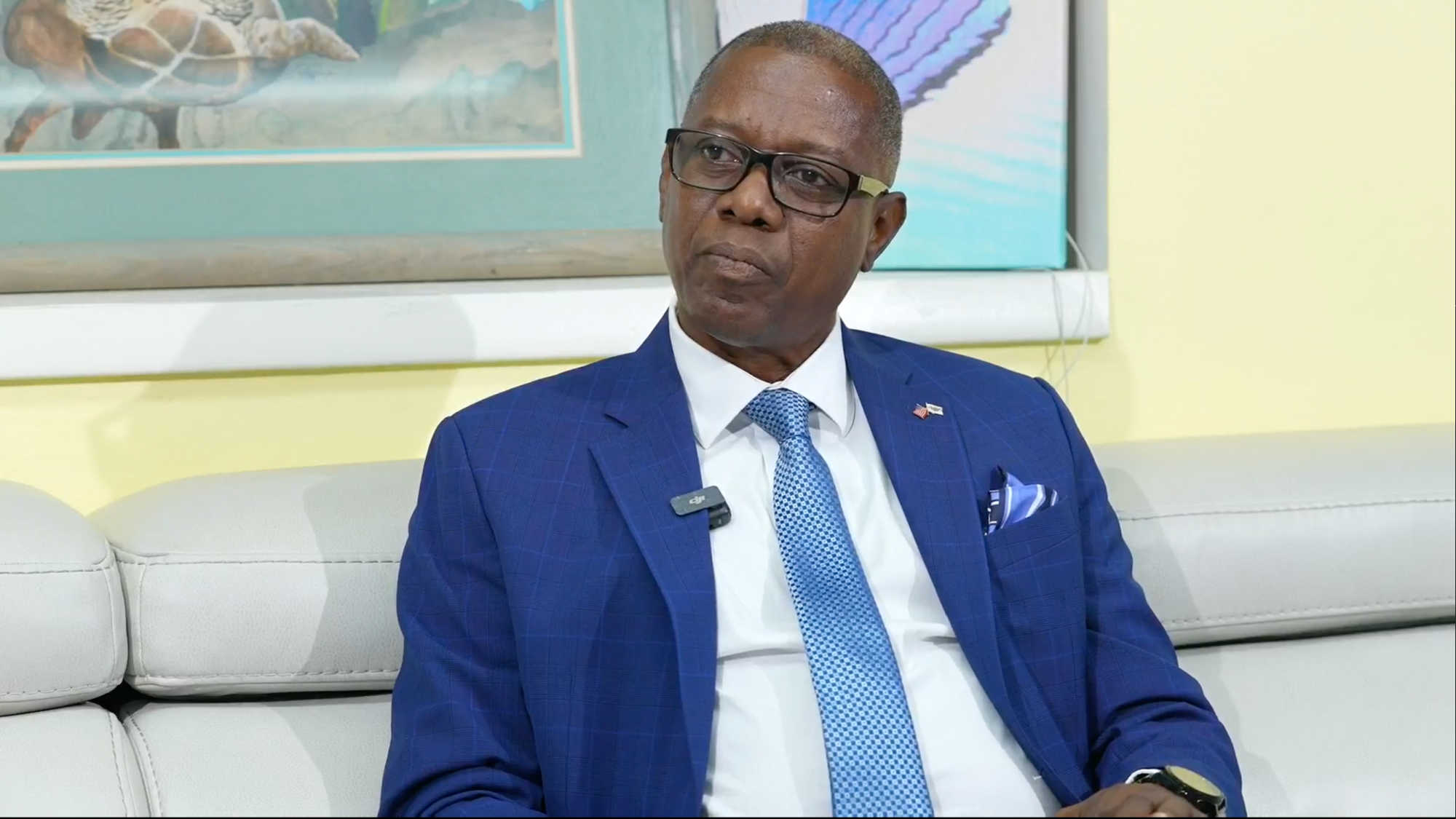
Democratic Senate candidate Dwight M. Cartier speaks during V.I. Consortium’s Election Cycle interview series, where his policy ideas on fuel, WAPA, healthcare and economic growth faced detailed questioning. Photo Credit: V.I. CONSORTIUM.
Democratic Senate candidate Dwight M. Cartier offered no clear immediate plan Thursday night to reduce fuel prices for Virgin Islanders, saying the territory has limited control over global oil markets and resisting the idea of suspending local fuel-related taxes even as residents face gas prices above $5 per gallon in some areas.

The exchange took place during V.I. Consortium’s Election Cycle interview series, which is being held ahead of the Democratic primary in August and the general election in November. The interviews are scheduled for Mondays, Wednesdays and Thursdays as the Consortium questions candidates on major issues facing the territory.
V.I. Consortium founder and publisher Ernice Gilbert asked Mr. Cartier what he would do in the first 30 to 90 days as a senator to bring relief to residents paying high fuel prices, which Mr. Gilbert linked to global pressure from the war in Iran. Mr. Gilbert noted that prices had climbed above $5 per gallon in some areas of St. Croix and were even higher on St. Thomas and St. John.
Mr. Cartier said the Virgin Islands does not have much influence over what happens in the United States or globally when it comes to oil and war. He said local leaders would need to examine the cost of bringing fuel into the territory and build consensus around possible responses.
“It's difficult when you're not in control,” Mr. Cartier said. “And we're not in control, I would say, of the gas prices here.”
Asked specifically for a 30-to-90-day plan, Mr. Cartier said any solution would require a group effort in the Legislature.
“That's something that I like to sit with my colleagues when I'm elected as a senator and see based upon the Organic Act, the revised Organic Act, knowing that we've got the power in the Legislature to do certain things to see what we could do about that,” he said. “But that's going to be a group action item.”
Mr. Gilbert pressed the point, saying group action usually begins with an individual proposal and that fuel prices are one of the greatest immediate concerns for Virgin Islanders.
Mr. Cartier said that in a 30-to-60-day window, with the United States involved in war and oil and gas at the center of global concern, he did not see “any real solid actions” that could bring prices back down.
“I don't see any, any real solid actions that could be taken to drive that down back to where it was,” he said.
Mr. Gilbert then pointed to local tools available to the government, including suspending certain fuel-related taxes, gross receipts taxes or gas taxes, or providing vouchers to Virgin Islanders. He said those measures could bring immediate relief even if they only reduced costs by 10, 15 or 25 cents per gallon.
Mr. Cartier resisted the idea of suspending taxes, saying the government also needs revenue.
“If we're going to take away some taxes, we're going to lose some monies there,” he said. “Someone hurts.”
Mr. Gilbert responded that the issue was immediate relief for residents already struggling to make ends meet while paying high fuel prices. Mr. Cartier said he understood that concern but argued that suspending taxes would also affect government services and revenue.
“The government needs its coffers at this,” Mr. Cartier said. “We need as much money in the coffers at this point.”
He said he would look for other ways to help residents, but did not identify a specific alternative during the exchange.
“I would have to look into how we can give the community relief on gas, with the exception of taking away or suspending these taxes,” he said.
Mr. Gilbert pushed back, saying high fuel prices are a current crisis and that candidates seeking to join the Legislature should already be studying existing law, tax policy and available tools.
“You don't believe the gas prices being $5 on St. Croix, $6-$7 on St. John is a crisis, right?” Mr. Gilbert asked.
“It's a crisis,” Mr. Cartier replied.
Mr. Gilbert then said that if it is a crisis, leaders must deal with it immediately. Mr. Cartier said he is not yet a senator and questioned why current leaders had not acted if the matter is being treated as a crisis.
“We have leaders out there that knows it's a crisis,” he said. “If we're considering it a crisis, then why aren't they?”
Mr. Gilbert responded that the interview was focused on Mr. Cartier because he is seeking to replace one of those leaders. He said a candidate running at this moment should have already examined the issue and potential remedies.
Mr. Cartier said he has been studying crises in the Virgin Islands but that his current priorities have focused on other major concerns.
“What I'm looking at is our major issues that affect the community,” he said, citing infrastructure, school maintenance, high cost of living and other long-standing problems.
The discussion then moved to how fuel prices affect groceries and consumer goods, since nearly everything consumed in the territory is imported. Mr. Gilbert asked how Mr. Cartier would hold supermarkets, wholesalers, shippers and retailers accountable to determine whether price increases are legitimate or whether residents are being exploited.
Mr. Cartier said the Department of Licensing and Consumer Affairs must be part of the solution. He said the agency may be doing well in some areas but not in others, and said the territory needs more collaboration between DLCA and sellers of goods.
“We need to make sure that we're able to go in and verify these prices and have a system set up, more of a benchmark set up that you could actually see what these prices are,” he said.
Mr. Cartier suggested that stores could be listed on a platform so residents would know what certain goods are expected to cost and could report disparities. He said consumers should be able to call attention to pricing differences and have them checked and corrected.
When Mr. Gilbert asked whether Mr. Cartier viewed grocery pricing and price gouging as a legislative matter, Mr. Cartier said no. “Everything is not just a legislative matter,” he said.
He described the issue as one of management, enforcement and routine inspection. “This is actually getting out there into the grocery stores, checking on items, and not just today, but a daily routine,” he said.
Mr. Cartier said the problem could be corrected, but did not identify a bill, statutory change, enforcement expansion, funding source or penalty structure that he would pursue as a senator.
The exchange left a clear divide between the candidate and the interviewer over immediate relief. Mr. Cartier acknowledged that high fuel prices are a crisis, but said tax suspension would hurt government revenue and that he would need to look further into relief options.



Advertisements