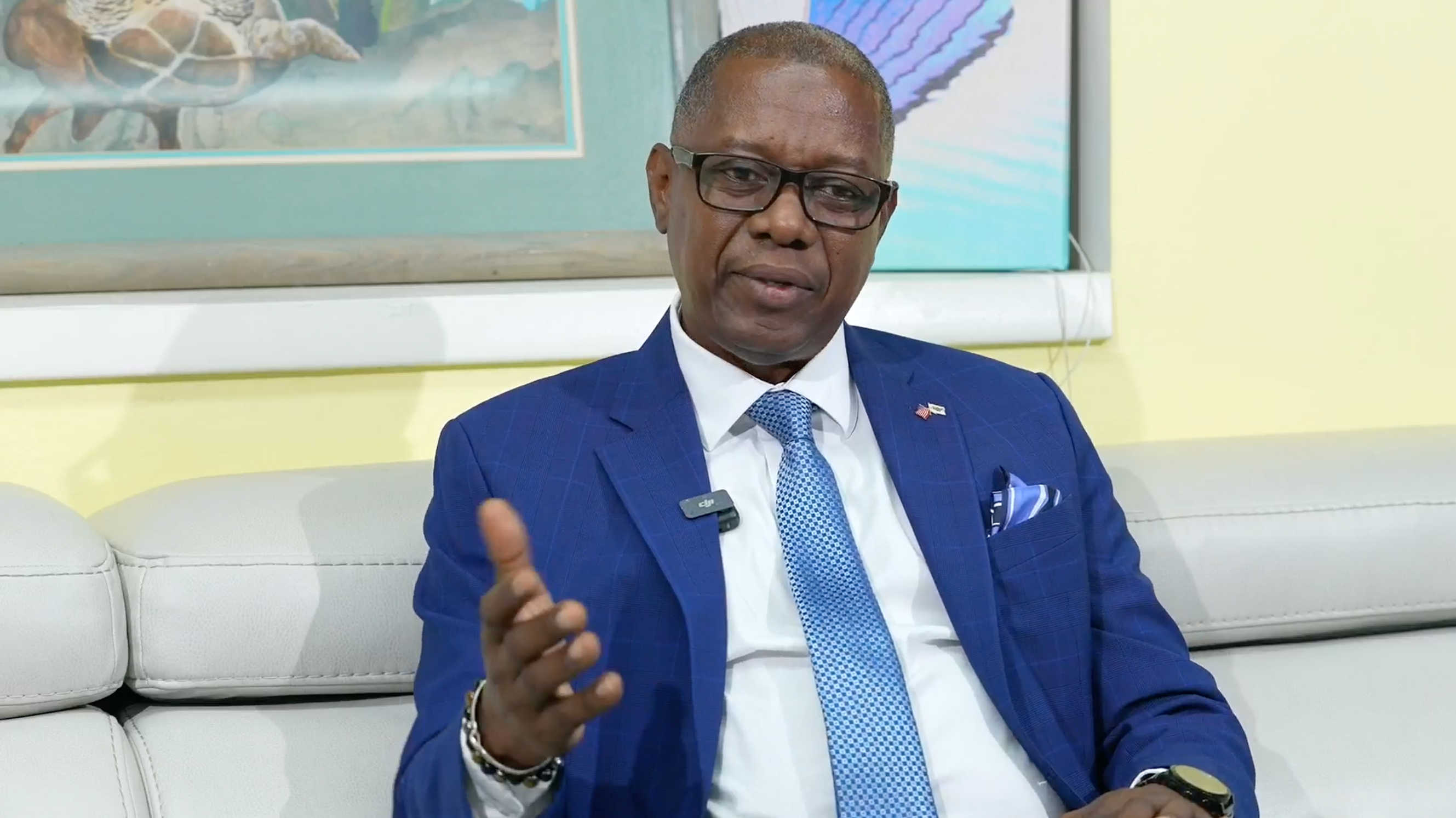
Democratic Senate candidate Dwight M. Cartier speaks during V.I. Consortium’s Election Cycle interview series, where his policy ideas on fuel, WAPA, healthcare and economic growth faced detailed questioning. Photo Credit: V.I. CONSORTIUM.
Democratic Senate candidate Dwight M. Cartier said Thursday night that his campaign is rooted in service, community needs and a desire to help St. Croix move forward, but his appearance on V.I. Consortium’s Election Cycle interview series also exposed repeated gaps between broad campaign ideas and the specific legislative tools, funding sources and timelines needed to carry them out.

The interview, conducted by V.I. Consortium founder and publisher Ernice Gilbert, was part of the Consortium’s ongoing election-year series ahead of the Democratic primary in August and the general election in November. The interviews are being held on Mondays, Wednesdays and Thursdays as the Consortium questions candidates seeking public office during a critical election cycle.
Mr. Cartier, who is seeking a Senate seat in the Democratic primary, introduced himself by saying he has been speaking with homeowners, knocking on doors and sitting at residents’ tables. He said he wanted the interview to be productive and later described his campaign in one word: service.
“I'm here to serve you,” Mr. Cartier said in his closing statement. “I'm here to serve you, your sister, your family, your friends, this community, the island of St. Croix.”
Before moving into policy, Mr. Gilbert opened with a public-record clarification involving a 2018 civil court filing from Jackson County, Georgia captioned Capital One Bank versus Dwight M. Cartier. The complaint alleged an unpaid account balance of just under $3,000. Asked whether the person named in the filing was him, Mr. Cartier said, “That's not me.”
He said there are multiple people with the name Dwight M. Cartier or similar names, and the interview moved forward.
The first policy test came on fuel prices. Mr. Gilbert asked what Mr. Cartier would do in the first 30 to 90 days to bring relief to Virgin Islanders facing fuel prices above $5 per gallon in some areas, with additional pressure from the war in Iran and the rising cost of oil.
Mr. Cartier said the territory has limited control over U.S. oil markets and global conflict, and said any response would require examining the cost of bringing fuel into the Virgin Islands and building consensus. He initially said he did not see “any real solid actions” that could be taken within 30 to 60 days to drive gas prices down.
When Mr. Gilbert pointed to possible local tools, including suspending fuel-related taxes, gross receipts taxes or gas taxes, or providing vouchers to residents, Mr. Cartier resisted the idea of suspending taxes, saying the government also needs revenue.
“I wouldn't suggest suspension,” he said. “The government needs its coffers at this. We need as much money in the coffers at this point.”
Mr. Cartier acknowledged that high fuel prices are a crisis, but said he had been focused on other major issues affecting the community, including infrastructure, school maintenance and the cost of living. Mr. Gilbert pushed back, noting that fuel prices are one of the most immediate pressures facing residents and that candidates seeking office should be studying available policy options before entering the Legislature.
The conversation then turned to grocery prices and consumer goods. Mr. Gilbert asked how Mr. Cartier would determine whether supermarkets, wholesalers, shippers and retailers are passing along legitimate fuel and freight increases or taking advantage of residents through inflated prices.
Mr. Cartier said the Department of Licensing and Consumer Affairs and retailers need more collaboration and that there should be a way to verify prices and create a system where consumers can compare what goods should cost. However, when asked whether this required legislation, Mr. Cartier said he viewed it more as a management issue than a legislative one.
“Everything is not just a legislative matter,” he said.
Mr. Cartier was also questioned about his experience inside the Legislature. He confirmed that he worked as an executive assistant in the office of Senator Javan James, but said he was not a researcher.
He described the role as managerial, saying he helped make sure the senator was prepared and that people were brought to the table. Asked what he saw from inside the Legislature that made him believe he should now become a senator, Mr. Cartier said he has always served in the background and believes the territory can do better in managing crises and getting ahead of problems before they become emergencies.
One of the clearest examples he gave involved the University of the Virgin Islands’ free tuition funding. Mr. Cartier said he would not fund such programs only one or two years at a time, but would look for multi-year funding over four, six or eight years to give the government time to identify additional money.
The interview also focused on Mr. Cartier’s WELL Initiative, which he described as a combination of campaign message, community work and legislative agenda built around wellness, education, leadership and listening. Asked to name the first bill that would come from the initiative, he identified mental health as a priority and said he wants to see a brick-and-mortar mental health facility.
“I would like to see and get involved and bring forth legislation that's going to actually really impact mental health here in the Virgin Islands, here in St. Croix, particularly,” he said.
Asked about funding, Mr. Cartier said most of the money would come from private sources rather than government funds. He described the potential funders as Virgin Islanders from St. Croix and St. Thomas who have done well financially and want to help the community. He did not identify the donors or give a cost estimate, saying he wanted to leave some details for later.
On WAPA, Mr. Cartier was pressed on his campaign writing that St. Croix can stabilize and modernize its grid within three years through renewable energy, battery storage, outside expertise, transparent billing and reduced dependence on imported oil. He said he looks at best practices and questioned why residents have not seen lower bills despite solar projects being developed in the territory.
Mr. Gilbert noted that WAPA and the administration have publicly said savings from solar generation are being held against the utility’s debt obligations before ratepayers see relief. Mr. Cartier said he did not accept that reasoning and argued that savings should be moved to the community, either in whole or in part.
When asked how he would force WAPA to pass along some of the savings, Mr. Cartier repeatedly referred to consensus and the Legislature’s authority. He later said one option would be requiring WAPA to split the savings, with part going to ratepayers and part going toward the utility’s obligations.
“Give the community 50 percent, you take 50 percent for your bills,” he said.
On economic development, Mr. Cartier said St. Croix needs to focus on small businesses, which he said are closing because of high operating costs, including electricity. But when Mr. Gilbert asked for a plan, Mr. Cartier initially stayed in broad terms before saying he has been in discussions with companies interested in the Caribbean and the U.S. territory market.
He said some companies are interested in coming to St. Croix but are deterred by infrastructure, including power, water and airlift. He later said his team is examining ways for companies to “circumvent” WAPA-related problems, though he did not provide full details.
On roads and drainage, Mr. Cartier said he would support mapping potholes and road conditions, using local contractors and allowing the public to see what work is being done. When Mr. Gilbert noted that the Department of Public Works already has a road-related public platform and pressed for funding sources and specific legal changes, Mr. Cartier said he did not want to disclose too much before his team had fully confirmed what was possible.
“When we determine the funding, we'll identify it,” he said.
On water quality, Mr. Cartier said WAPA must be held accountable and that benchmarks should be set. Asked about the major Land and Water Use moving through the Department of Planning and Natural Resources, he said he was “a little familiar with it” but returned to the need for shorter-term relief, management and accountability while longer-range projects move forward.
On crime and public safety, Mr. Cartier said police need equipment, technology and salaries that allow them to do their jobs. He cited conversations with police officers who told him equipment should be a priority. He said public safety is tied to funding, which led the discussion back to the need for revenue-generating economic ideas.
Healthcare also drew sustained questioning. Mr. Cartier has written that too many St. Croix patients are forced to leave the island for care. Asked which services must be restored first, he spoke about the hospital’s systemic problems, unpaid bills and staffing challenges before being pressed again to name specific services. He eventually pointed to surgical units, intensive care support and cardiology as areas needing greater capacity.
On education and workforce development, Mr. Cartier said schools should train students in trades and that his WELL Initiative ties into broader workforce development. He said he is working to connect his plans with companies that could offer jobs and training budgets, and said funding for UVI’s free tuition program should be structured on a multi-year basis.
Housing proved another area where Mr. Cartier acknowledged the seriousness of the problem but said his proposals were still being worked on. He said the government should consider rules protecting both renters and landlords, including limits on sudden rent increases, but did not provide final legislative language.
“We're working on the right framing, the right wording,” he said.
Mr. Cartier was later asked about agriculture, an area he described as one of his top priorities. He said the territory must invest in farming, expand land access, support crop development and move toward sustainability. When Mr. Gilbert pressed him on funding, Mr. Cartier gave one of his more defined structural proposals: creating a centralized grants department and a separate grant-administration department.
He said the government loses federal funds because it cannot always meet requirements on time, and argued that dedicated grant-writing and grant-administration structures could help the territory capture and manage money for agriculture and other needs.
The interview also included a discussion of Mr. Cartier’s previous commentary responding to a “come home” message aimed at Virgin Islanders living abroad. He said the message rubbed him the wrong way because many people left the territory due to the very conditions local leaders have not fixed, including lack of opportunity and high costs. He said some residents abroad are helping relatives back home financially, and that asking them to return without improving conditions ignores reality.
“We have to put structure in place here in order to ask these people to come home,” Mr. Cartier said.
In his closing statement, Mr. Cartier said voters should expect him to focus on infrastructure, healthcare, school maintenance and the essential issues affecting daily life on St. Croix. He said he is running to serve and to help move solutions forward.
“What you will receive from me as a senator is someone that's focused on the community,” he said.



Advertisements