

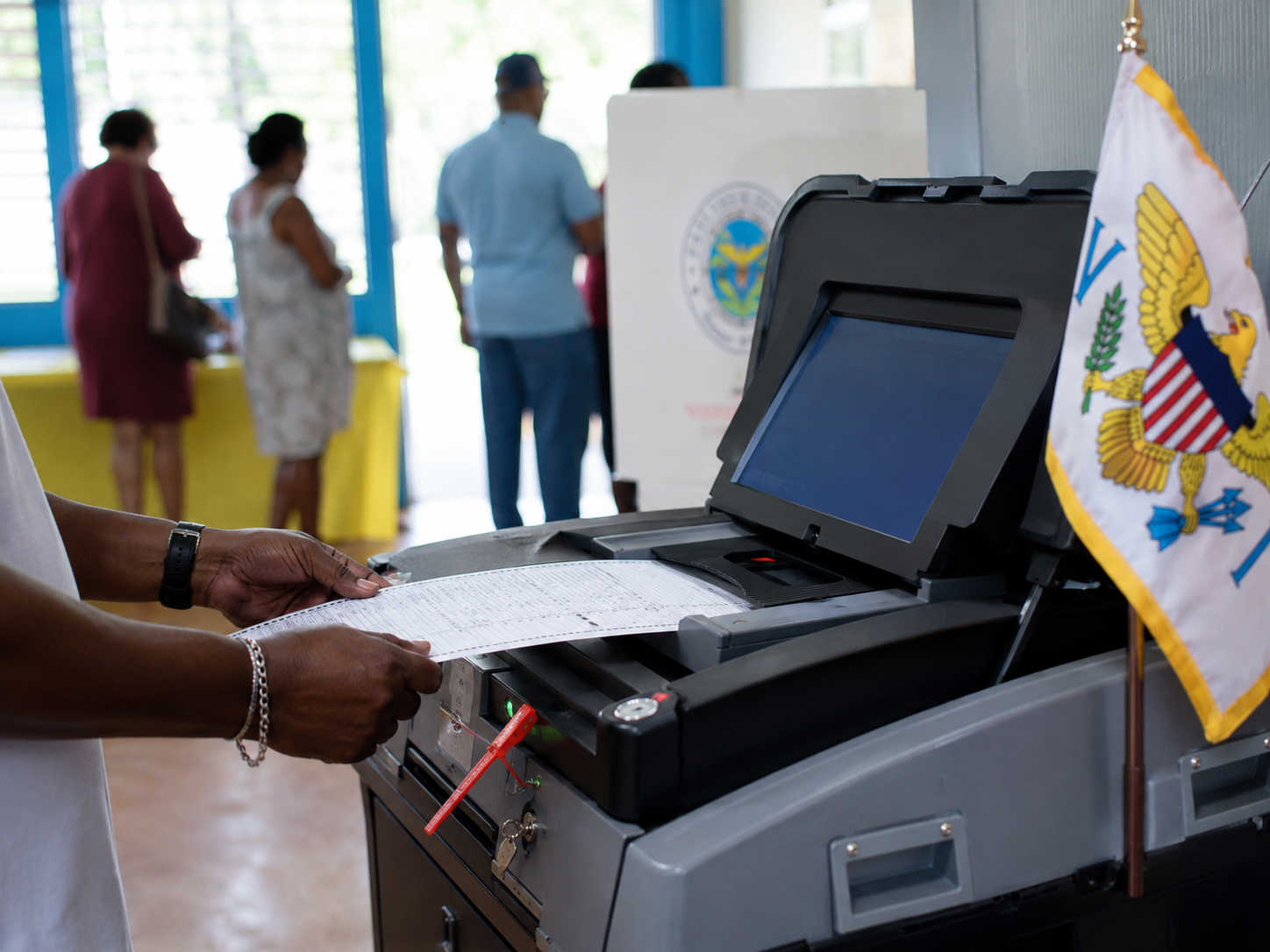
With the 2026 election season underway, lawmakers on Thursday advanced a series of election-related measures touching on primary election funding, candidate eligibility, campaign contribution limits, early voting and political signs.

A total of five election-related proposals were either special ordered or introduced as non-germane amendments during Thursday’s Legislative Session. Despite pushback on several items, each advanced to Governor Albert Bryan Jr. for further action.
The first was Bill No. 36-0294, special ordered by Senator Novelle Francis. The measure appropriates $400,000 from the General Fund of the Government of the Virgin Islands to the Elections System of the Virgin Islands to fund the Democratic primary election later this year.
Senator Alma Francis Heyliger, an independent, was the first to voice strong opposition.
“I will not be supporting this because I'm not paying for anybody's primary,” she said.
She argued that political parties have gone to court to assert their independence, and questioned why the government should fund one party’s primary. She contrasted the Democratic Party with the Republican Party, saying the Republican Party “puts their money where their mouth is, and it's less than 1000 of them.”
“If you're going to have that type of boasting that there's 30,000 plus registered Democrats, maybe you should fundraise,” Senator Francis Heyliger said. She argued that it was “unfair” for one party to generate its own funding while “the Democrats want to tell you that they could do what they want with their party, but the government needs to pay for it.”
Independent Senator Dwayne DeGraff took a similar position.
“I vehemently opposed to that. It's not fair to the people of the territory,” he declared.
Mr. DeGraff also questioned the $400,000 amount, noting that the figure had been lower in previous years. Senator Francis said the amount was adjusted because of rising costs.
He said the funding was needed to support a “fair, transparent, and accountable election,” and clarified that the Elections System of the Virgin Islands had requested the amount “to ensure that they have sufficient money available to address some of the issues they're seeing there with the increased cost, inflation, cost of living, and everything else that's impacting them.”
Senate President Milton Potter, a Democrat, also defended the appropriation, saying “a functioning democracy depends on a well-resourced election system.”
Senators DeGraff, Francis Heyliger and Kenneth Gittens ultimately voted against the bill.
Mr. Gittens later introduced two election-related amendments, both of which prompted questions from Senator Francis Heyliger.
The first dealt with candidate eligibility and public office. Senator Gittens said the amendment provides that “a person who has been convicted of a felony offense or crime involving moral turpitude shall be ineligible to qualify for, be elected to or hold any public office in the Virgin Islands unless the person has received a full pardon restoring civil rights.”
The amendment also states that those convicted of a sex crime will be “permanently ineligible to hold public office unless expressly pardoned with restoration of such eligibility.” It also addresses policies involving background checks and reviews.
“The people deserve assurance that candidates who will be serving them meets clear ethical and all legal standards,” Senator Gittens said.
Thirteen of the fifteen senators signed onto the measure. Senators Alma Francis Heyliger and Marise James were not listed as sponsors. Senator James was absent from Thursday’s session.
The Legislature’s legal counsel confirmed that the amendment does not violate constitutional provisions, responding to a concern raised by Senator Francis Heyliger.
Ms. Francis Heyliger also questioned a second amendment introduced by Senator Gittens, this one addressing campaign donations.
The proposal amends Title 18, Chapter 29 of the Virgin Islands Code to increase the campaign contribution cap from $1,000 to $3,500. Senator Francis Heyliger asked for the “impetus for such a high increase.”
Mr. Gittens said the cap had not been updated in decades.
“this measure has not been updated since 1990,” he said.
Senator Francis Heyliger was not persuaded by that explanation, recalling her own prior attempt to update a dated law dealing with the amount the government may pay a member of the public injured by a government employee while on the job.
“If you want to tell me about inflation, maybe you should have that same passion…and please raise the $25,000 to at least $100,000 because since 1976 it hasn't been changed,” she told Senator Gittens.
Mr. Gittens responded that she was comparing “apples and oranges.”
Senator Kurt Vialet agreed that the two issues were different, saying Senator Francis Heyliger’s proposal involved funding from the General Fund, while campaign contributions do not.
“You can't conflate those two issues, where you're talking about contributions going to somebody that is running, with the Government of the Virgin Islands providing monies for tort claim,” he said.
Mr. Vialet said the recommendation to increase and “equalize” the cap came from the Board of Elections and the Elections System.
Senator Vialet also introduced a proposal related to early voting. His amendment to Title 18 provides that early voting shall conclude no earlier than the close of business on the day immediately before election day.
He explained to Senator DeGraff that in most states, “early voting doesn't end one two weeks before the actual election.” Mr. Vialet said the amendment is intended to correct a long gap between early voting and election day.
“This is just correcting a long period of time between individual voting and the machine sitting there in the Board of Election for, at times, more than a week before the actual election day comes,” he said.
Senator DeGraff ultimately supported the proposal.
The final election-related amendment came from Senator Marvin Blyden and concerned Title 21 of the Virgin Islands Code. It seeks to distinguish between commercial advertisements and “temporary non-commercial signs.”
Under the amendment, such signs could include a “poster, notice, or other advertising device that is temporary in nature,” “does not propose a commercial transaction” and “communicates a message concerning an election…”
Senator Blyden said the amendment “corrects constitutional and policy deficiencies introduced by Bill Number 32-0059” and “protects non-commercial speech, because it's protected by the First Amendment.”

Although some lawmakers raised objections or declined to support certain measures, all five election-related proposals advanced to Governor Bryan for further consideration.


Advertisements