

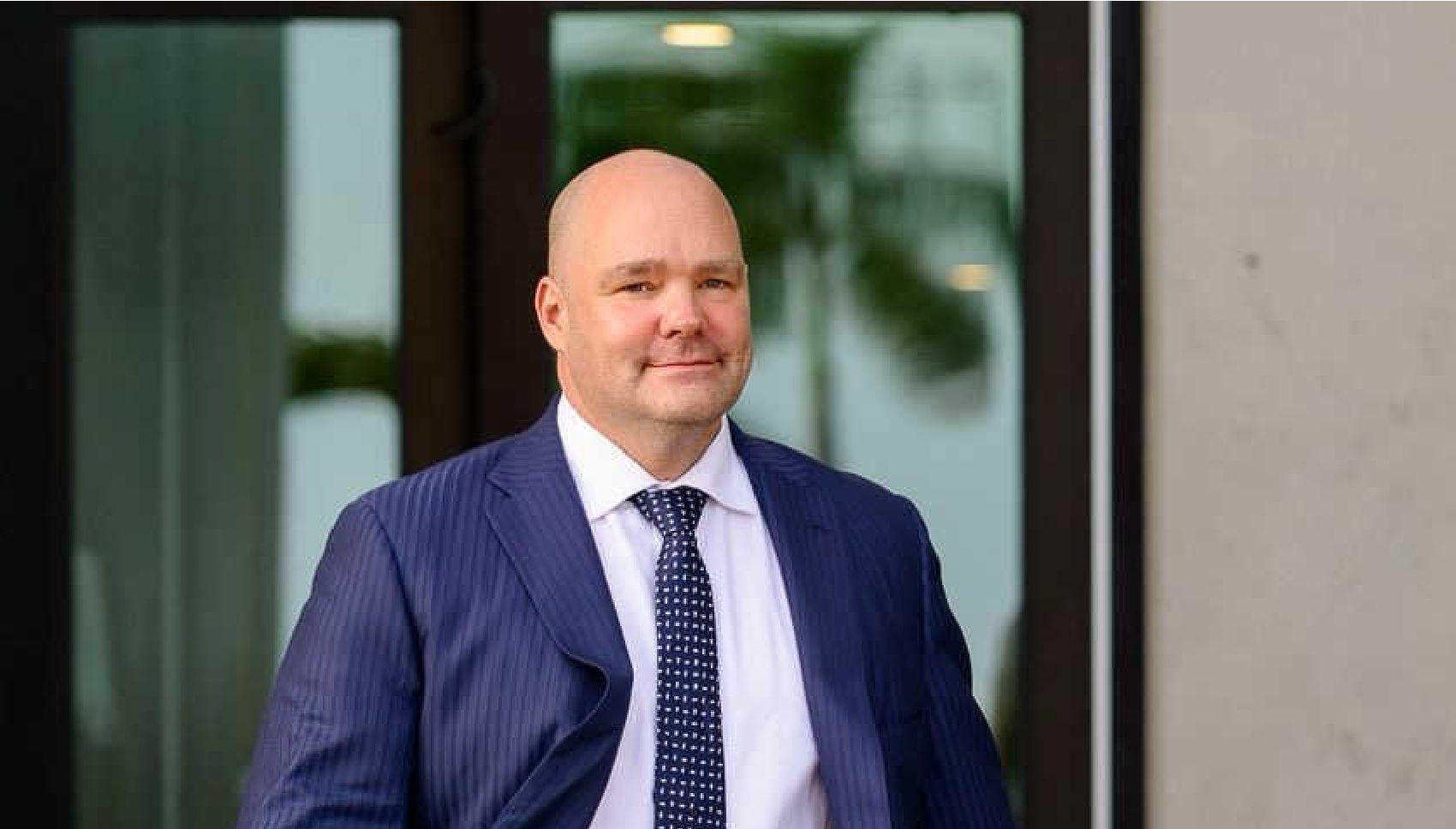
David Whitaker pleaded guilty on September 12, 2024 to two counts of wire fraud and one count of bribery concerning programs receiving federal funds. Photo Credit: WTJX.
Federal prosecutors are asking the District Court to sentence Mon Ethos founder David Whitaker to 22 months in prison, while his defense is seeking probation with home detention, arguing that his cooperation helped secure convictions in two major Virgin Islands public corruption cases and that his medical condition requires continuity of care outside federal custody.

The competing sentencing memoranda place sharply different emphasis on the same defendant. Prosecutors describe Mr. Whitaker as a repeat fraud offender whose conduct helped corrupt government decision-making and undermined public trust. His defense portrays him as a central cooperator whose testimony helped federal prosecutors break through what it described as a long-standing “wall of silence” in Virgin Islands public corruption cases.
Mr. Whitaker pleaded guilty on September 12, 2024 to two counts of wire fraud and one count of bribery concerning programs receiving federal funds. The case involved three areas of admitted conduct: a false claim that he had found additional surveillance devices in government offices, a federal Paycheck Protection Program loan application containing false statements, and bribes connected to his company’s work with the Virgin Islands Police Department.
According to prosecutors, the applicable sentencing factors support a custodial sentence of 22 months, followed by three years of supervised release. The government says such a sentence would be “sufficient but not greater than necessary” to reflect the seriousness of the offense, promote respect for the law, deter future conduct and account for Mr. Whitaker’s history.
The government’s memorandum says Mr. Whitaker committed three distinct fraud offenses while operating Mon Ethos in the Virgin Islands. Prosecutors argue that the schemes “all revolved around Whitaker’s greed and desire to grow his business by whatever means necessary.”
Federal prosecutors also point to Mr. Whitaker’s prior criminal history, calling him “a repeat fraudster.” The memorandum cites prior convictions for bank fraud in 1997, forging checks in 2000, and a 2008 fraud scheme in which victims were defrauded of more than $9 million. The government argues that those prior convictions did not stop him from committing fraud again.
Prosecutors also say deterrence is especially important because the case involved public corruption. According to the government, the bribery scheme eroded public confidence in the integrity of government decision-making.
“The citizenry should be able to trust that their public officials are making decisions based on what is in the best interest of the people of the Virgin Islands,” the government wrote.
The government said the bribery scheme charged in the case involved Ray Martinez, then the highest-ranking law enforcement officer in the territory, and was difficult to detect. Prosecutors say Mr. Whitaker helped obscure bribe payments by drafting false documents tied to a purported show called “Steak Out.”
Mr. Whitaker’s defense, however, argues that his cooperation changed the course of multiple federal investigations. In his sentencing memorandum, attorney David J. Cattie states that Mr. Whitaker testified for the United States in two separate public corruption trials: United States v. Martinez & O’Neal and United States v. White & Hendricks.
Those cases have formed a major part of the territory’s recent public corruption landscape. The Consortium previously reported that former Police Commissioner Ray Martinez and former Office of Management and Budget Director Jenifer O’Neal were convicted on all counts in a federal corruption case built on secret recordings, inflated invoices and a $17,730 lease payment prosecutors said was tied to O’Neal’s planned Java Grande coffee shop at Yacht Haven Grande.
The Consortium also reported that former Department of Sports, Parks and Recreation Commissioner Calvert White and contractor Benjamin Hendricks were convicted of honest services wire fraud and bribery concerning federal programs after a trial in which Mr. Whitaker was a key government witness.
According to the defense memorandum, Mr. Whitaker’s testimony was subject to sustained cross-examination in both trials, including attacks on his criminal history, guilty plea and cooperation agreement. The defense argues that both juries nevertheless credited his testimony and convicted all four defendants.
The filing also notes that Judge Mark Kearney later denied post-trial motions by Mr. Martinez and Ms. O’Neal. The Consortium reported last week that the judge found ample evidence to support those convictions and wrote that “The adduced evidence overwhelmingly confirmed the officials’ disregard for the rule of law.”
Mr. Whitaker’s defense says the government has moved under U.S.S.G. § 5K1.1 for an eight-level downward departure because of his cooperation, lowering the advisory sentencing range from 46 to 57 months to 18 to 24 months. Prosecutors’ public memorandum also states that the United States believes the offense level should be lowered to 14, which corresponds with the same post-departure range.
The defense says Mr. Whitaker’s cooperation was “critical” and “pivotal,” quoting the government’s sealed filing as saying that without the information he provided, it is unlikely prosecutors would have developed enough evidence to charge Mr. Martinez, Ms. O’Neal, Mr. White or Mr. Hendricks.
Mr. Cattie argues that Mr. Whitaker engaged in corrupt conduct with only one of those four defendants: Mr. Martinez. As to the White and Hendricks prosecution, the defense says Mr. Whitaker acted under FBI direction, made recorded calls, attended recorded meetings and made an FBI-approved and reimbursed payment to capture White and Hendricks soliciting and arranging a bribe.
The defense contends that public reporting and the indictment left some readers believing that Mr. Whitaker was a corrupt participant in the White and Hendricks bribery scheme, when the defense says he was acting as a cooperating witness in that matter.
“He has carried that false public accusation because he cooperated,” the defense wrote.
The defense acknowledges Mr. Whitaker’s wrongdoing. It says he accepts the offense conduct, the advisory guideline calculation and the $600,098.10 restitution figure. That amount includes $130,195.10 tied to the surveillance-device fraud and $469,903 tied to the PPP loan matter.
Count One arose from a VIPD investigation into surveillance devices in government offices. According to the defense memorandum, after one miniature camera surfaced, Mr. Whitaker falsely claimed to have found additional devices and billed VIPD $130,195.10. In his statement to probation, the filing says, Mr. Whitaker said, “There is no excuse for it.”
Count Two arose from a February 2021 second-draw PPP application for Mon Ethos that requested $469,903 and contained false statements about wages, compensation and related tax payments. The defense says Mr. Whitaker maintains that the funds were used for permitted purposes, including paying workers, and that he did not seek forgiveness. The defense nevertheless concedes that the false statements were “inexcusable.”
Count Three involved bribes to Mr. Martinez, then VIPD commissioner. The government says Mr. Martinez accepted approximately $100,000 in bribes from November 2022 through June 2024, including equipment and labor for his restaurant, luxury all-expense-paid trips to Boston, sporting-event tickets, tuition payments for his children and rent payments for a new home.
The defense places the start of that corrupt relationship in the context of unpaid Mon Ethos invoices. It says Mr. Whitaker had performed work for VIPD and, by November 2022, was “pretty desperate to be paid.” The defense argues that the corrupt bargain grew out of an effort to be paid for work actually performed, though it acknowledges that this does not excuse the bribery.
The government says the scheme later expanded beyond invoice payments to include a one-year sole-source contract worth up to $1,489,683. That contract was funded by the American Rescue Plan Act and became central to the Martinez-O’Neal prosecution.
The defense also raises medical and safety concerns in asking for probation with home detention. Mr. Cattie argues that Mr. Whitaker has an active, complex medical workup underway in Georgia, including oncology and neurological evaluations, and that incarceration could disrupt treatment. The memorandum also says Mr. Whitaker’s prior experiences in custody involved medication problems and that his public status as a cooperator could create safety risks in prison.
Mr. Whitaker’s primary request is probation with 18 to 24 months of home detention at an approved residence in Georgia. If the court believes a longer non-custodial sentence is necessary, the defense proposes 36 to 48 months of home detention. If the court requires prison time, the defense asks for the shortest term the judge finds sufficient, not more than one year and one day, with permission to self-surrender after roughly six months so that pending medical evaluations can be completed.
The defense also proposes conditions including location monitoring, treatment compliance, no work on government contracts or government-funded programs, financial disclosure, no new debt without probation approval, no contact with witnesses or co-defendants except through approved channels, and restitution payments. The defense says $30,000 is available for an initial restitution payment upon entry of the sentencing order.
Prosecutors reject a non-custodial outcome, arguing that a prison sentence is necessary because of the seriousness of the fraud and bribery conduct, Mr. Whitaker’s criminal history, and the need to deter white-collar crime and public corruption.
“The public deserves to have federal funds used for the benefit of the citizenry,” prosecutors wrote. “The defendant’s selfishness and greed hurt the very community that was supposed to receive the federal benefit dollars implicated in this case.”
Prosecutors argue that a sentence below the guideline range could lead public officials and the businesspeople who bribe them to believe “that the potential benefits of corruption outweigh the costs.”



Advertisements