
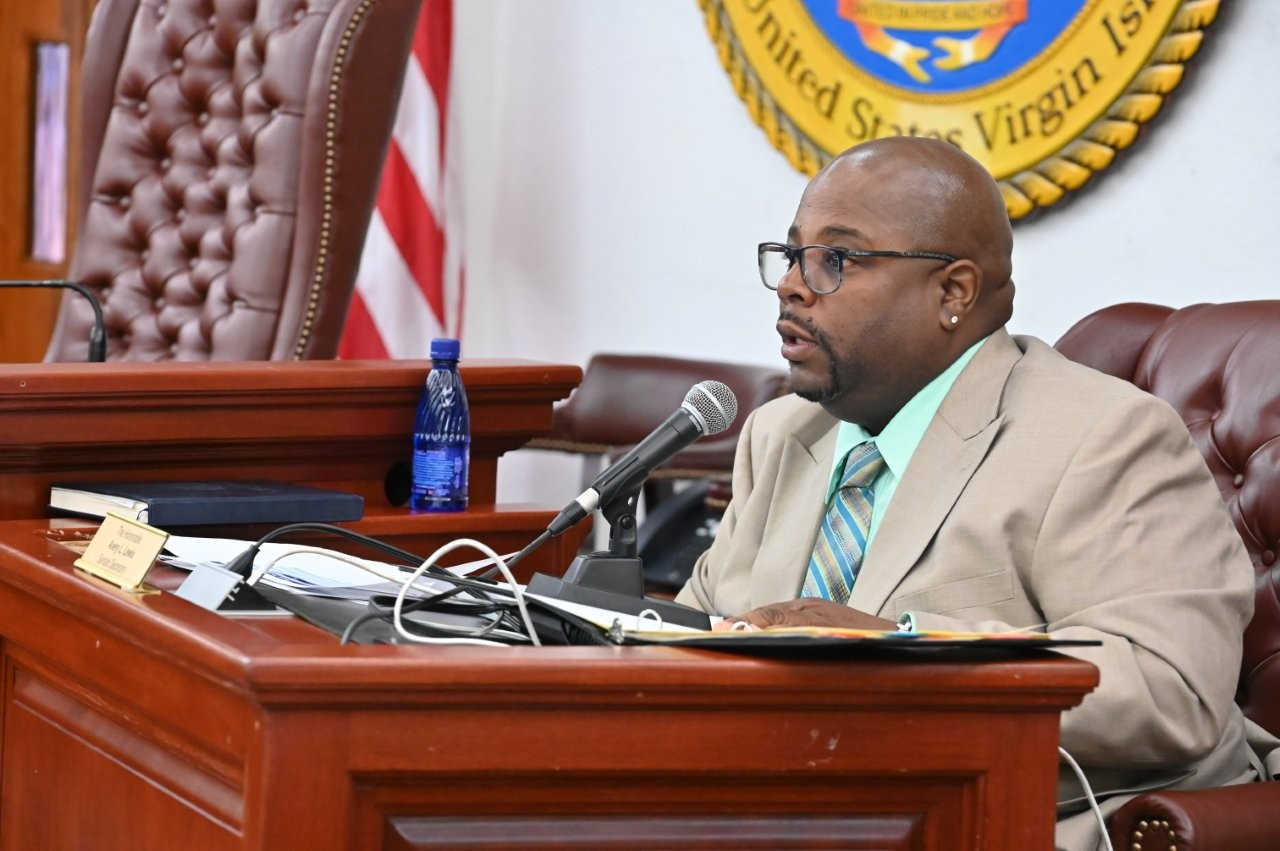
Senator Avery Lewis. Photo Credit: V.I. LEGISLATURE.
Senator Avery Lewis held a bill in committee Thursday after the Department of Property and Procurement and the Department of Justice argued that his proposal to impose civil liability for damage to government vehicles and property was duplicative and unnecessary under existing law.

Bill No. 36-0139 was heard in the Committee on Homeland Security, Justice and Public Safety. The measure seeks to amend Title 31 of the Virgin Islands Code to assess civil liability for the destruction of or damage to government property through willful or negligent acts.
The title of law the bill seeks to amend already addresses the destruction or damage of government property, whether willful or negligent. Mr. Lewis’s measure proposed adding new sections that would specifically impose penalties on an individual who “willfully or negligently damages a government vehicle” or allows a government vehicle entrusted to their care to be stolen or damaged in “any manner.”
Under the proposed language, that individual would be “civilly liable for the cost of the repair to the vehicle, including the cost of the material and the labor to complete such repairs or for the cost of the vehicle at book value.”
Another proposed section would impose an identical penalty on anyone who negligently damages government property, including “fencing, lighting, and other non-permanent structures.” Mr. Lewis also sought to apply the penalty to “any person entrusted with the custody and care of real property owned by the government who allows the property to be stolen or damaged in any manner.”
Introducing the bill, Mr. Lewis said the measure was intended to strengthen accountability for repeated instances of damage to government property.
He told colleagues that despite recurring damage, “very little accountability follows when a government vehicle is wrecked because of negligence.” He said the public is also affected when government equipment is not available for use.
“when government assets are unavailable because they are awaiting repairs, the public loses services, the community suffers,” Mr. Lewis said.
The senator acknowledged opposition from both the Department of Property and Procurement and the Department of Justice, whose representatives repeatedly described the proposal as “duplicative” and “not necessary.”
Mr. Lewis said he was not fully persuaded.
“If those mechanisms are sufficient…why do we continue to see government vehicle damaged and left unrepaired?” he asked.
“The issue before us is not whether some authority exists somewhere within policy contracts or administrative procedures. The issue is whether accountability is occurring consistently. From what the public sees, the answer is often no,” Mr. Lewis declared.
Property and Procurement Commissioner Lisa Alejandro testified that current law already addresses the concern raised in the bill.
“Existing statutes and established processes already address these objectives,” she said, adding that “the Department does not believe the additional statutory authority is warranted, given its duplicative nature.”
Ms. Alejandro said Title 31 already provides that government officials or employees are “financially responsible for any physical damage according to a government motor vehicle as a proximate result of negligence concerning the same.”
She also addressed the bill’s provisions involving people who are not government employees, saying the government already has legal avenues available.
“Currently, the government can seek recovery from non-employees responsible for damaging government vehicles through civil litigation or insurance claims,” Ms. Alejandro said.
She ultimately asked lawmakers not to approve the measure, saying “we believe the intent of the bill can be achieved through interagency coordination and departmental and stakeholder operations under the existing framework.”
The Department of Justice took a similar position. Patricia Lynn Pryor, appearing for DOJ, said the concern raised by the bill was legitimate but that the proposed legislation was not needed.
“Although Bill 36-0139 addresses a very legitimate concern, I believe it is not necessary,” she stated.
Ms. Pryor warned that overlapping statutes can create problems rather than solve them.
“duplicative laws should be avoided, as they are an inefficient use of resources that can lead to significant problems, including inconsistency in the law, and as a result, arbitrary enforcement,” she said.
Committee members offered few substantive comments on the bill. After hearing the concerns from the agencies, Mr. Lewis agreed to hold the measure in committee, and his colleagues supported that decision.



Advertisements